


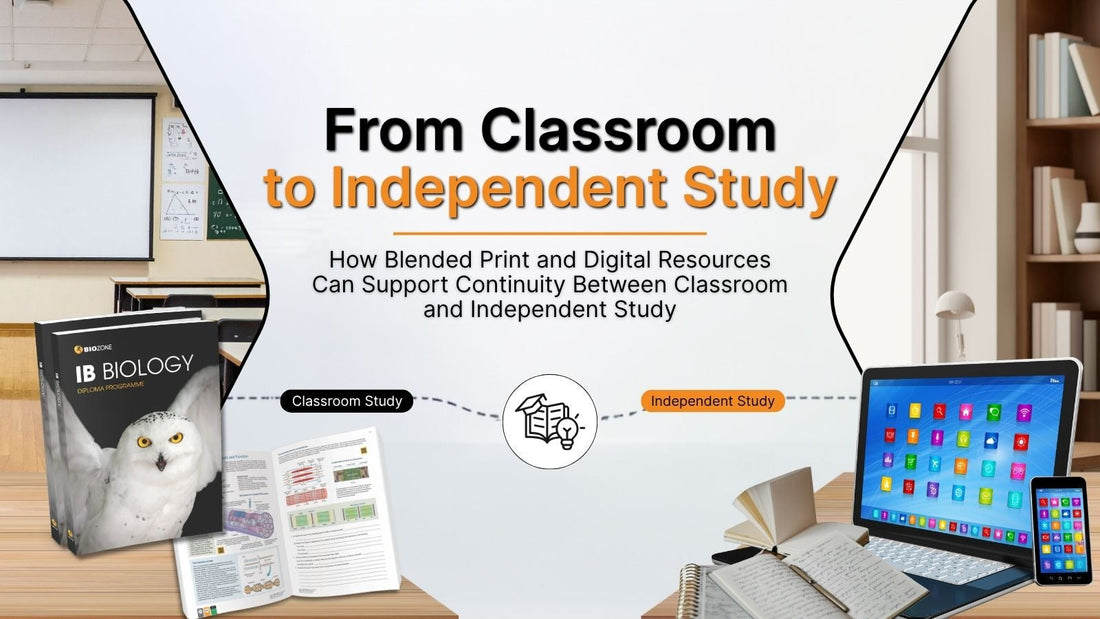
A student can understand a science lesson clearly at 10:30 in the morning and still feel lost when revisiting the same topic at home that evening.
The problem is not always the difficulty of the science. Sometimes it is the break in the learning journey.
In class, the teacher may explain a concept using a printed resource, a diagram and discussion. Homework may sit on another platform. Revision notes may come from a third source. Videos, worksheets and assessment practice may be stored somewhere else again.
Each resource may be useful on its own. But if students have to keep rebuilding the connection between them, learning can become fragmented.
This is why the discussion around print and digital science resources should move beyond a simple question of which format is better.
A more useful question is:
How can print and digital resources work together so that learning continues smoothly from the classroom into homework, independent study and revision?
The Real Challenge Is Continuity, Not Format
Schools are often encouraged to think in terms of print versus digital. In practice, the two formats solve different problems.
Print can provide focus, structure and a physical record of learning. Digital resources can add access, multimedia support, teacher workflow and opportunities for students to continue working beyond the lesson.
The strongest approach is therefore not necessarily to replace one with the other.
It is to decide what each format should do and how students will move between them.
For international schools, this matters because science learning does not happen in one place or at one moment. Students encounter a concept during instruction, work with it through activities, revisit it during homework, test their understanding through questions and return to it again before an assessment.
When those stages feel connected, students spend less effort working out where their learning is and more effort working on the science itself.
Why Print Still Matters in Science Learning
Digital learning has expanded quickly, but that does not make print obsolete.
Science often benefits from deliberate, visible interaction with information. Students may need to annotate a diagram, write alongside an explanation, compare two processes, mark a graph or work through a question step by step.
A well-designed printed resource can give that work a stable home.
It can also create a record of progress. Students can see earlier answers, teacher comments, corrections and notes in context rather than treating each activity as an isolated task.
For some learners, the physical sequence of pages also helps make the course feel more manageable. They can see where a topic begins, how ideas build and how much they have already completed.
The value of print is therefore not simply that it is familiar.
Its value comes from what students are able to do with it.
Where Digital Resources Extend the Learning Experience
Digital science resources become most useful when they add something that print cannot provide as easily.
That might include:
-
access to videos, animations or interactive models
-
links to carefully selected supporting material
-
the ability to enter and submit work digitally
-
teacher assignment and feedback workflows
-
access to learning materials outside the classroom
-
additional support for visual or interactive exploration
A digital resource does not become educationally valuable simply because it is online. Its value depends on how clearly it connects with what students are already learning.
If students watch a video that has little relationship to the lesson, the experience may be interesting but disconnected.
If the same video is linked to a specific concept, question or activity, it can deepen understanding at exactly the point where the student needs it.
That connection is what turns digital content into part of a learning system rather than an extra collection of links.
Blended Learning Should Not Mean Duplicating the Same Material
One common mistake in blended learning is assuming that digital simply means placing the printed material on a screen.
A digital replica can be useful, particularly when students need access away from school, but a genuinely connected learning experience should think beyond duplication.
Schools should ask what the digital layer contributes.
Does it help students interact with the material? Can it connect them with visual resources? Can they continue an activity outside class? Can teachers assign, review or respond to work? Does it make revision easier to navigate?
At the same time, schools should avoid creating a situation where students must check five different systems to complete one piece of learning.
More technology does not automatically mean better continuity.
Sometimes the better digital strategy is the one that gives students fewer places to search.
Building a Bridge From Classroom to Independent Study
The real test of a blended resource strategy comes after the lesson ends.
Imagine a student learning about gene expression, ecological relationships or energy transfer during class.
During the lesson, the teacher introduces the concept and students work with diagrams, questions or data. Later, the student needs to revisit the same idea independently.
A connected resource system should make the next step obvious.
The student should know:
-
where the core explanation is located
-
which activity reinforces the concept
-
where supporting visual or digital material can be found
-
how to check what they have understood
-
what to revisit if their answer is incomplete
-
where to return when preparing for assessment
This continuity is especially important for international examination students, who are often expected to apply knowledge rather than simply recognise familiar wording.
Independent study becomes more effective when students are not starting from zero each time they open their books or log in.
They should be continuing a learning process that began in the classroom.
What This Means for Teachers
Blended resources should also make sense from the teacher's side of the desk.
Teachers already manage lesson planning, explanation, activities, homework, feedback, differentiation, practical work and assessment preparation. A resource system that adds more platforms without adding clarity can increase complexity rather than reduce it.
When schools evaluate digital science resources for schools, practical teacher questions matter:
-
Can the digital material be used alongside the main student resource?
-
Can teachers direct students to a specific activity or supporting item?
-
Is student work visible in a form that is practical to review?
-
Can the resource support homework and independent study without creating a separate learning pathway?
-
Are teacher materials clearly connected with the student content?
-
Does the system help teachers maintain a coherent sequence across classroom and home learning?
The objective is not to automate teaching.
It is to give teachers resources that support their professional judgement without forcing them to rebuild the learning journey every time students move between formats.
What This Means for Students
Students experience blended learning very differently from the people selecting the platforms.
A school may see a print programme, a digital licence, a learning management system and a library of online resources.
A student may simply see four different places where something important might be hiding.
Good resource design reduces that uncertainty.
Students should understand what the main learning path is and where digital elements fit into it.
For example, a print activity might establish understanding while a linked animation makes a process easier to visualise. A digital response might allow the student to continue the same work at home. Teacher feedback can then bring the learner back to the relevant concept.
Each step should feel connected to the previous one.
That is particularly valuable for students building independence. Instead of always asking, “What am I supposed to study?”, they can learn how to navigate the resource structure themselves.
Revision and Assessment: Continuity Matters Here Too
The quality of a blended resource strategy often becomes most visible during revision.
Students preparing for an assessment do not simply need more content. They need to know what they understand, what they have forgotten and what they still need to practise.
A connected print and digital approach can support this by keeping explanations, activities, annotations, supporting media and question practice related to the same learning sequence.
Students can return to the work they completed earlier rather than building an entirely new revision system just before an examination.
This does not mean that one resource should contain every possible revision tool.
It means the core learning record should make it easier to find the next useful action: reread, review a diagram, watch a supporting explanation, attempt another question or correct an earlier misunderstanding.
A Practical Checklist for Schools Reviewing Print and Digital Resources
Before adopting or expanding a blended science-resource model, Heads of Science, curriculum coordinators and teaching teams can ask a few practical questions.
1. Is each format doing a clear job?
Print and digital should complement each other. If they simply duplicate everything, the additional platform may add little educational value.
2. Can students move between formats without losing context?
A student should be able to recognise how a digital activity, video or assignment connects with the topic being taught.
3. Does the digital layer support learning rather than distract from it?
Multimedia and interactive features should serve a clear academic purpose.
4. Can teachers use the system within their existing teaching workflow?
The resource should support planning and delivery rather than create unnecessary administrative work.
5. Does it support independent learning?
Students should be able to continue learning outside the classroom with a clear sense of what to do next.
6. Is the resource useful across the academic year?
The strongest resources can contribute during instruction, homework, reinforcement, revision and assessment preparation.
7. Are availability and access conditions clear?
Digital access, licence terms and title availability can differ. Schools should confirm the specific arrangement that applies to the resources they are considering.
Where BIOZONE Fits Into a Blended Resource Strategy
BIOZONE's approach is built around the idea that students should interact directly with science content rather than only read it.
Its print worktexts combine explanatory content with visual material, questions and activities so that students can work within the same learning context.
BIOZONE WORLD extends that approach digitally. BIOZONE Asia currently describes the platform as providing digital replicas of print titles, digital recording of student work, curated videos and weblinks, interactive 3D models and teacher-support features including assignment workflow, student management, grading and teacher notes.
The important point is not the number of features.
It is the possibility of connecting a student's printed learning experience with digital access and support without creating an entirely separate course.
For schools exploring BIOZONE digital resources, the practical question should therefore remain the same as it would for any blended solution:
Does this combination make it easier for teachers and students to maintain a coherent learning journey?
Digital access and licence conditions should always be checked for the specific title, institution and market before adoption.
A Connected Learning Journey Is the Goal
The future of science learning does not need to be framed as a contest between paper and screens.
Students still benefit from focused reading, writing, annotation and structured activity. They can also benefit from digital access, visual media, interactive resources and teacher feedback tools.
The opportunity lies in bringing those strengths together intentionally.
When print and digital science resources are planned as parts of the same journey, classroom learning does not have to stop when the lesson ends.
Students can carry the thread of the subject into homework, independent study and revision with greater clarity about where they are, what they have done and what they need to do next.
For schools, that is the real measure of a blended resource strategy—not how many platforms are available, but whether those resources help create continuity in learning.
Explore BIOZONE Digital Science Resources
Schools and educators exploring blended print and digital science learning can review BIOZONE WORLD and the digital-resource information currently available through BIOZONE Asia.
Explore BIOZONE Asia Digital World:
https://biozoneasia.com/pages/digital-world