


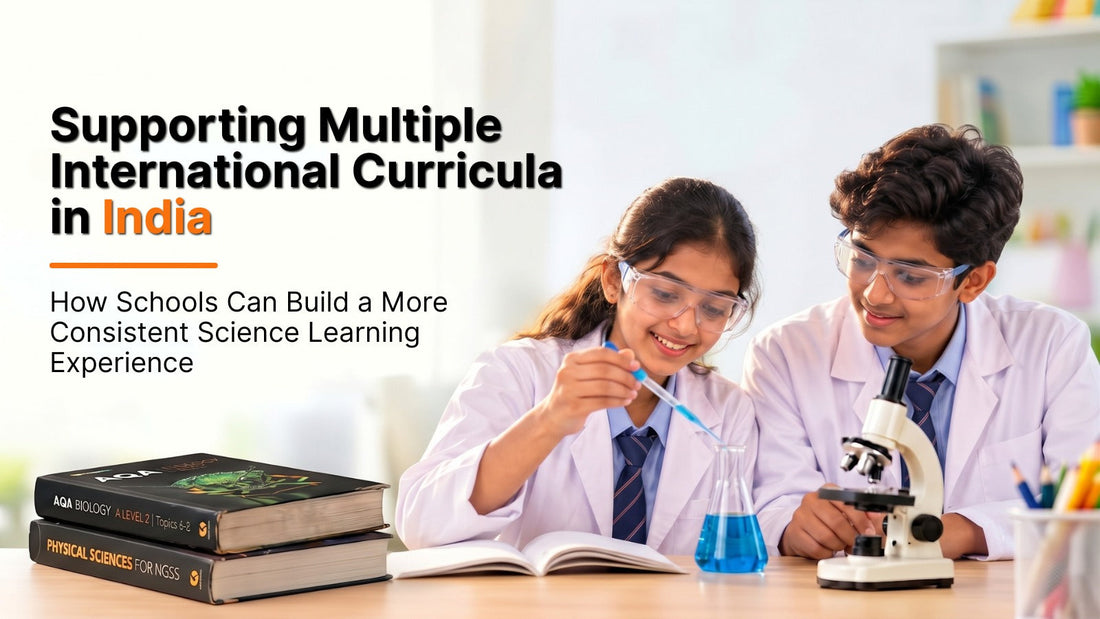
An international school can offer more than one curriculum pathway and still want students to experience science as one coherent discipline.
In India, that challenge is increasingly relevant. A school may work with IB, Cambridge International, Advanced Placement or other international programmes across different year levels, departments or student groups. Each pathway has its own terminology, structure, assessment expectations and academic priorities.
Those differences matter. Good curriculum alignment should never be replaced by a generic resource that tries to serve every programme in the same way.
But there is another question worth asking.
Even when the curriculum changes, should the quality of the learning experience change completely?
For many schools, the difficulty is not a shortage of content. It is fragmentation. Students may use a conventional textbook in one course, teacher-created worksheets in another, a separate digital platform for homework and a revision guide only when examinations approach. Teachers then have to connect those pieces themselves, while students have to work out how the pieces fit together.
The strongest science resources for international schools in India should therefore do two things at the same time: respect the curriculum being taught and support a consistent way of learning science.
That consistency does not mean making every programme identical. It means establishing clear learning principles that can travel with students and teachers from one curriculum context to another.
Different Curricula, One Need for Coherent Science Learning
IB Biology, Cambridge International Biology and AP Biology are not interchangeable programmes. Their structures, learning objectives and assessment requirements differ, and resource selection should reflect those differences.
However, the underlying demands of strong science learning often have important points in common.
Students need to understand concepts rather than merely recognise terminology. They need to read diagrams, interpret data, reason from evidence, connect ideas, work through questions and revisit their thinking when an answer does not make sense.
Teachers need materials that can support explanation, classroom activity, homework, practical work, revision and assessment preparation without forcing them to rebuild the learning sequence from scratch.
This is where a school-wide resource philosophy becomes useful.
Instead of asking whether every science course uses the same type of book, a department can ask whether its different resources encourage the same high-quality learning behaviours.
Resource Fragmentation Can Become a Learning Problem
Fragmentation often develops gradually.
A teacher may adopt one textbook because its explanations are strong. Another resource may be added for worksheets. A digital platform may provide videos. Past-paper material may be introduced later for examination preparation. None of those choices is necessarily poor in isolation.
The problem appears when students experience them as separate systems.
They read information in one place, answer questions somewhere else, submit work through another platform and keep revision notes in a fourth location. The teacher may understand how those pieces connect, but the student does not always see the same structure.
In science, that disconnection matters because understanding develops through repeated interaction with ideas. A diagram becomes more useful when the learner has to interpret it. A concept becomes more secure when it is applied. Data becomes meaningful when the student has to explain what the pattern suggests.
A coherent resource strategy should therefore reduce unnecessary movement between disconnected materials and make the learning pathway easier to follow.
Start With Programme Fit — Not a Generic Science Book
Consistency should never come at the expense of curriculum accuracy.
The first question when evaluating international curriculum science books should still be straightforward: does this resource genuinely fit the programme, level and syllabus being taught?
Schools should check the current curriculum or syllabus version, the expected depth of content, the balance between knowledge and skills, practical requirements, assessment expectations and the role the resource is intended to play.
A resource may be academically strong and still be the wrong choice if it was designed for a different programme or stage.
This is particularly important for Biology because similar topics can appear across curricula while being organised, assessed or emphasised differently.
Cell biology, genetics, ecology or physiology may be familiar headings, but programme alignment depends on far more than the chapter title.
For a multi-curriculum school, the objective is therefore not to find one universal science book. It is to select programme-specific resources that still support a recognisable standard of learning quality.
Build Consistent Learning Habits Across Curriculum Pathways
A useful way to think about consistency is to focus on what students are repeatedly asked to do with scientific information.
Across different courses, strong resources can encourage a sequence such as:
-
Clear explanation
-
Strong visual understanding
-
Student interaction
-
Application in questions or unfamiliar contexts
-
Use of data and evidence
-
Review, correction and reflection
-
Independent study
This sequence is not a curriculum. It is a learning pattern.
A student first needs enough explanation to understand the idea. Visuals can then clarify relationships, processes or structures. Questions and activities require the learner to do something with the information. Application reveals whether understanding can transfer. Data and evidence develop scientific reasoning. Review helps the learner identify gaps. Independent study allows the cycle to continue outside the classroom.
When resources repeatedly support those behaviours, students are less dependent on a single teacher explanation or a last-minute revision period.
They begin to recognise how science learning works.
Consistency Should Not Mean Standardisation
There is an important distinction between consistency and standardisation.
Standardisation can imply that every class should use the same material in the same way. That would be inappropriate across genuinely different international curricula.
Consistency is different.
A school can maintain common expectations for resource quality while allowing each programme to retain its own curriculum structure.
For example, one course may require a particular style of data analysis while another gives more emphasis to extended response, inquiry or practical skills. The resources should respect those differences.
At the same time, both resources can still be visually clear, activity-led, logically sequenced and useful for independent study.
This is a more realistic goal for international schools: not identical resources, but a consistent standard for how well those resources help students engage with science.
Teacher Usability Matters Across Programmes
A multi-curriculum school also has to consider the teacher experience.
Teachers working across international programmes already manage curriculum interpretation, lesson planning, practical work, assessment, feedback, differentiation and revision support. If every course uses a completely different resource system, the planning burden can increase unnecessarily.
Well-structured science teaching resources for schools can give teachers a stronger starting point.
Useful characteristics may include clear learning progression, well-placed questions, diagrams that can be used instructionally, data activities, teacher editions or model answers where appropriate, supporting presentation material and digital resources that are relevant to the specific title.
The purpose is not to prescribe how a teacher should teach.
Experienced teachers will adapt any resource to the needs of their students. The value lies in reducing avoidable reconstruction so that more teacher time can go towards explanation, discussion, practical work, feedback and intervention.
For school leaders and Heads of Science, teacher usability should therefore be part of resource evaluation rather than an afterthought.
Give Students a Clear Route From Classroom to Independent Study
Resource consistency becomes especially valuable when students leave the classroom.
During a lesson, a teacher can explain difficult ideas, answer questions and redirect misunderstandings. At home, the learner has to navigate the material more independently.
A useful science resource should make that transition easier.
Students should be able to return to an explanation, recognise the relevant diagram, understand what a question is asking, check how ideas connect and identify what needs further review.
This does not mean that books or digital resources replace the teacher. They do not.
It means the resource should remain usable when the teacher is not physically beside the student.
For international-school students balancing demanding programmes, this continuity between classroom learning, homework and revision can be particularly valuable.
It also helps the resource remain useful throughout the academic year rather than becoming a classroom-only object or an exam-season revision tool.
Evaluate the Learning Design, Not Only the Content List
When schools compare biology textbooks for international schools in India, content coverage is naturally one of the first things they examine.
But two resources can cover similar topics and create very different learning experiences.
A stronger review therefore looks at learning design as well as the table of contents.
Schools can ask:
-
Is the resource aligned to the correct curriculum, level and syllabus year?
-
Are explanations clear without oversimplifying the science?
-
Do diagrams, photographs, graphs and models contribute to learning rather than simply decorate the page?
-
Are students regularly required to write, interpret, calculate, compare, explain or apply?
-
Does the resource develop scientific reasoning through data and evidence?
-
Can teachers use it effectively for lessons, homework, revision and assessment support?
-
Can students use it independently outside direct instruction?
-
Do print and digital components, where available, support one learning journey?
-
Are institutional access, licensing and purchasing conditions clear?
This kind of review shifts the discussion from 'Does the book contain the topic?' to 'How will students and teachers actually use this resource?'
That is a much more useful question for academic decision-making.
Print and Digital Should Work as One Learning System
International schools increasingly work across both physical and digital environments.
The answer is not automatically to replace print with digital, or digital with print.
The more useful objective is continuity.
Printed resources can provide focus, annotation, written work and a stable record of learning. Digital support can extend access to selected interactive resources, videos, models, online activities, assignment functions or teacher materials where those features are available for the title and institutional arrangement.
The formats are most useful when they reinforce the same learning sequence.
A student might work through an activity in print, access a supporting digital resource, submit work online and later return to the same topic for revision. The movement should feel connected rather than like a collection of unrelated platforms.
Explore BIOZONE Science Resources
International schools, science departments and educators can explore BIOZONE Asia's programme-specific science resources and learning solutions for different curriculum pathways.
Explore BIOZONE Asia:
Schools should therefore verify the digital support available for the specific programme and title rather than assuming that every product carries the same entitlement or functionality.
Where BIOZONE Fits
BIOZONE's approach is relevant to this discussion because the brand develops programme-specific science resources while maintaining a recognisable learning philosophy across many of its titles.
The core idea is the interactive worktext: a format that combines the visual and explanatory strengths of a textbook with the active, write-on functionality of a workbook.
Instead of separating explanation from activity, the worktext approach places scientific stimulus material, diagrams, data, questions and student responses close together. This encourages students to interact directly with the science and build a visible record of their learning.
Through BIOZONE Asia, schools can explore programme-specific resources across areas including IB Biology, Cambridge International Biology, AP Biology and NGSS, alongside broader Biology and science subject collections.
That does not mean one BIOZONE title is designed to serve all of those programmes.
The value is the opposite: each programme should be approached through the resource developed for that curriculum, while schools can still look for familiar principles such as visual clarity, structured activity, application, scientific reasoning and independent learning.
Depending on the title and institutional arrangement, supporting teacher and digital resources may also be available through Teacher's Editions, Resource Hub materials or BIOZONE WORLD. Exact availability, licensing and access should always be checked for the specific resource.
For schools comparing BIOZONE science books or other resources for international schools, this makes it possible to evaluate programme alignment and learning design together rather than treating them as separate decisions.
A More Consistent Science Learning Experience Is a Strategic Choice
International curricula are designed to be distinct. A school should not try to erase those differences.
But students do not benefit when every curriculum pathway also creates a completely different way of navigating science.
A stronger resource strategy preserves programme-specific accuracy while creating greater consistency in the learning behaviours students practise: understand, interpret, interact, apply, reason, review and learn independently.
For teachers, that can mean more coherent resource use across lessons, homework and revision.
For students, it can mean fewer disconnected materials and a clearer sense of how to work with scientific ideas.
For school leaders, it creates a more useful standard for comparing resources: not simply whether they cover content, but whether they contribute to the kind of science learning the school wants to build.
That is the opportunity for international schools in India.
Different curricula can remain different, while the quality of the science learning experience becomes more consistent.