


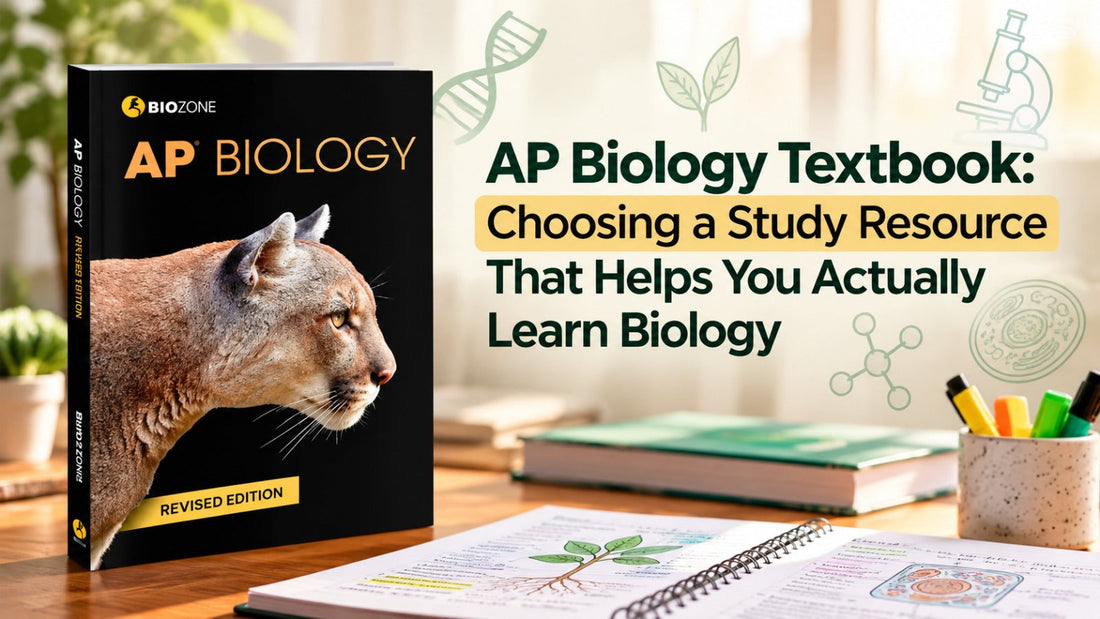
Studying AP Biology can feel very different from studying a subject where remembering facts is enough. There are plenty of terms to learn, of course, but knowing the terminology is only the starting point. Students also need to understand biological processes, interpret diagrams, work with data, evaluate evidence and explain what is happening in an unfamiliar situation.
That makes the choice of an AP Biology textbook more important than it may first appear.
A book can contain hundreds of pages of information and still not be particularly useful when a student has to apply that information to a question. On the other hand, a well-designed worktext can encourage students to stop, think, write, analyse and return to concepts they have not fully understood.
This is the approach behind the BIOZONE AP Biology - Student Edition (4th Edition). Designed around the AP Biology curriculum and updated for the 2025 Course and Exam Description (CED), the book combines biological content with activities, visual material, questions and opportunities for students to build a record of their own work.
AP Biology Requires More Than Memorisation
There is a common assumption that success in biology means learning a large number of definitions.
That certainly helps. But AP Biology asks students to do considerably more.
The College Board describes the course as one that develops skills such as designing experiments, collecting and analysing data, interpreting data, and supporting scientific claims with evidence. The exam itself also tests students on scientific methods, visual representations, calculations and data analysis.
This changes what students should expect from their study material.
For example, knowing the definition of natural selection is useful. Being able to examine a population, interpret evidence of changing traits and explain why one biological outcome is more likely than another is a different skill altogether.
The same applies to genetics, cellular energetics, cell communication and ecology.
A useful AP Biology study resource should therefore encourage students to use biological knowledge, not just read it.
That is one of the reasons the worktext format is worth considering.
What Is Different About a Worktext?
A conventional textbook is generally designed around reading. You work through an explanation, look at diagrams and perhaps answer a few questions at the end.
A worktext takes a slightly different route.
The BIOZONE AP Biology Student Edition encourages students to interact directly with the material. Students can record answers in the context of the stimulus material, creating a record of work that can later be revisited during revision.
That sounds like a small difference, but it can change the way a student studies.
Instead of reading a section and moving immediately to the next one, the student has to stop and respond. Sometimes the answer will be right. Sometimes it will not. Both are useful because the process makes gaps in understanding easier to identify.
And when revision time arrives, those completed activities become more than pages in a textbook. They provide a trail of what the student has worked through.
Updated for the 2025 AP Biology CED
One of the most important considerations when choosing an AP Biology textbook is whether the material reflects the current course framework.
The BIOZONE AP Biology - Student Edition (4th Edition) has been updated to align with the 2025 AP Biology Course and Exam Description. The edition includes new and updated activities, revised chapter introductions, refreshed Science Practice and Big Idea coding, and updated alignment with the CED.
The College Board identifies the AP Biology Course and Exam Description as the core document for the course and states that it was updated for 2025-26.
For students, current alignment matters because an older resource may not always reflect the way the course is currently structured.
It does not mean an older biology textbook suddenly becomes useless. Biology itself has not changed overnight. But when a course framework is updated, having a study resource that has been revised around that framework gives students and teachers a more relevant starting point.
Nine Units Cover the Main Areas of AP Biology
The BIOZONE fourth edition follows a structured unit-based approach.
The student book includes:
-
Chemistry of Life
-
Cell Structure and Function
-
Cellular Energetics
-
Cell Communication and Cell Cycle
-
Heredity
-
Gene Expression and Regulation
-
Natural Selection
-
Ecology
-
Science Practices for AP Biology Students
The first eight units cover the major biological areas students encounter during the AP Biology course. The ninth unit has a somewhat different purpose. Rather than focusing on another broad biological topic, it brings attention to the scientific practices students need to develop.
That is a useful distinction.
Students may understand photosynthesis, for instance, but still need practice interpreting experimental results related to photosynthesis. Similarly, knowing how DNA replication works does not automatically mean a student will be comfortable analysing a graph or experimental scenario involving gene expression.
The content and the scientific skills have to work together.
Science Practices Are Part of the Learning
This is perhaps one of the more valuable aspects of the fourth edition.
AP Biology is not simply a course in remembering biological vocabulary. Students are expected to work with evidence and scientific information.
The current AP Biology exam includes 60 multiple-choice questions and six free-response questions, with each section accounting for 50% of the score. The questions can involve biological concepts, diagrams, scientific methods, calculations, experimental results and data analysis.
So students need opportunities to practise those skills before they sit the exam.
The BIOZONE book incorporates activities designed around information analysis and scientific thinking. Its dedicated Science Practices unit also gives students a place to focus specifically on these abilities.
This is useful because scientific reasoning is not something most students become comfortable with simply by reading about it.
You need to practise it.
A Visual Approach to Biology
Biology can become complicated very quickly.
A page discussing cellular respiration, gene expression or cell signalling can contain a lot of information. Add diagrams, pathways, structures and unfamiliar terminology, and students can sometimes lose the bigger picture.
The BIOZONE AP Biology worktext uses a highly visual presentation to make biological concepts more accessible. The supplied product information also highlights QR-linked access to interactive 3D models associated with activities.
For visual learners, this can make a real difference.
Instead of trying to imagine the structure of a biological system entirely from written descriptions, students can work with diagrams and supporting visual resources. It gives another way of approaching the same concept.
And sometimes seeing a process is what makes the explanation finally click.
Activities Give Students Something to Work With
A major strength of an activity-based AP Biology textbook is that it creates opportunities to engage with the subject while learning it.
The fourth edition contains a wide range of activities designed to support information analysis and scientific thinking. The book also includes assessment activities with multiple-choice and free-response questions.
This matters because there is a significant difference between thinking, 'Yes, I understand this chapter,' and actually sitting down with a question and producing an answer without looking at the explanation.
The second one tells you much more.
If a student gets an activity wrong, that is not necessarily a problem. In fact, it can be one of the more useful parts of studying. The mistake identifies something that needs another look.
Over time, that process can make revision more focused.
Support for Practical Investigations
Laboratory and investigation work is another important part of AP Biology.
The BIOZONE fourth edition provides support for the 13 required practical investigations, according to the supplied product information.
This helps connect textbook learning with practical scientific work.
Students are not only expected to know what a biological process is. They should also understand how biological questions can be investigated, how evidence is collected and how results can be interpreted.
For example, understanding experimental variables, controls and data does not become particularly meaningful if these ideas are treated as isolated definitions. They make much more sense when students see how those concepts fit into an actual investigation.
That connection between theory and investigation is something a good AP Biology resource should encourage.
A Record of Work Can Make Revision More Useful
Revision is often where students discover the weaknesses in their understanding.
A chapter that seemed straightforward a month ago may suddenly feel less clear when it comes time to revise for an assessment.
The BIOZONE worktext approach addresses this by allowing students to record answers alongside the learning material. This creates a personal record that can be revisited later.
There is a practical advantage here.
Rather than starting from a completely blank page every time they revise, students have something to return to. They can see the questions they answered, the concepts they worked through and the areas where they may need additional practice.
For students who prefer structured revision, that can be much easier to manage.
Digital Resources Extend the Learning Experience
The Student Edition is also supported by digital resources.
According to the product information, BIOZONE WORLD brings together resources including digital versions of student editions, model answers, presentation slides, classroom guides and other supporting materials.
Student access can include an interactive digital replica of the book, the ability to enter answers online and access related resources such as 3D models, presentation slides, curated videos and web links.
There is also a BIOZONE Resource Hub providing free resources for students and teachers, including videos, animations, games, 3D models, spreadsheets and source material.
This means the printed textbook does not have to be treated as a standalone resource.
A student can start with the printed activity, use an associated digital resource when needed and then return to the question or concept.
For today's students, that combination of print and digital learning can be particularly practical.
Helpful for Teachers as Well as Students
Although this article is focused on choosing an AP Biology textbook for students, the wider resource structure is also relevant to schools and teachers.
The programme includes a Teacher's Edition with model answers and a classroom guide. Other resources include presentation slides, a question library and access to BIOZONE WORLD.
For teachers, having these supporting resources available can reduce the need to build every classroom activity from scratch.
The classroom guide also explains the pedagogy behind the worktext and provides guidance around assessments and required investigations.
For a school adopting a structured AP Biology programme, that wider support can be just as important as the student book itself.
Who Is the BIOZONE AP Biology Student Edition For?
The fourth edition is particularly suited to students who want more than a traditional read-and-revise textbook.
It may be a good fit for students who:
-
Prefer learning through activities and visual material
-
Want to practise applying biological concepts
-
Need structured support for AP Biology revision
-
Want a resource aligned with the 2025 CED
-
Need more practice with scientific reasoning and data
-
Like having a written record of their learning
-
Want both print and supporting digital resources
It can also be useful for teachers and schools looking for a student worktext that can sit alongside classroom teaching and practical investigation.
Of course, no single book can replace the complete learning process. Students still need their teacher's guidance, classroom discussions, laboratory experience, practice questions and regular revision.
But the right textbook can bring many of those learning activities into a more organised structure.
Choosing an AP Biology Textbook Is About How You Learn
There are plenty of AP Biology resources available today. Some are designed mainly for revision. Others focus heavily on exam questions. Some are traditional textbooks, while others are digital-first.
The important question is not simply which book has the most information.
Ask instead: Will this resource make me work with the biology?
That is where the BIOZONE AP Biology - Student Edition (4th Edition) takes a different approach.
It combines curriculum-aligned content with activities, visual learning, scientific practices, assessment questions, practical investigation support and digital resources. It has also been updated around the 2025 AP Biology CED, giving students a current framework to work from.
For a student preparing for AP Biology, that combination can provide a more active way to learn the subject.
Biology is a subject that rewards curiosity. It also rewards practice. Sometimes the best way to understand a difficult concept is not to read the explanation one more time, but to try a question, look carefully at the evidence and work out why the answer makes sense.
That is ultimately what a good AP Biology textbook should help students do.
Explore the AP Biology - Student Edition (4th Edition)
The BIOZONE AP Biology - Student Edition (4th Edition) is available through BIOZONE Asia.
https://biozoneasia.com/products/ap-biology-student-edition-4th-edition
For official information about the current AP Biology course, assessment structure and Course and Exam Description, students and teachers can refer to the College Board AP Biology course and exam information:
https://apstudents.collegeboard.org/courses/ap-biology