


There is a point in advanced Biology where knowing individual facts is no longer enough. Students may understand what a hormone does, describe how respiration works, recall patterns of inheritance, or explain the principle of natural selection. The greater challenge is being able to connect those ideas, interpret evidence, recognise relationships between processes and apply biological knowledge when the context is unfamiliar.
That shift becomes especially important during OCR A Level Biology Year 2.
Within OCR Biology A, the full H420 A Level qualification extends across Modules 1–6. The advanced Year 2 material associated primarily with Modules 5–6 builds on earlier foundations and takes students into increasingly interconnected areas of Biology. Communication, homeostasis, energy transfer, genetics, evolution and ecosystems may appear to be distinct areas of study, but successful understanding increasingly depends on seeing how biological processes influence one another.
For students, this means moving beyond remembering content. For teachers and science departments, it means providing learning experiences that help students organise knowledge, interpret biological information and apply concepts with greater independence.
WHY OCR A LEVEL BIOLOGY YEAR 2 DEMANDS MORE CONNECTED THINKING
The progression into Year 2 is not simply a matter of adding more chapters to an existing body of knowledge. The nature of the learning itself becomes more demanding.
Earlier Biology study establishes essential foundations: biological molecules, cells, exchange systems, biodiversity and other core principles. In the later stages of the course, students are increasingly expected to bring such knowledge together.
A question about homeostasis, for example, may involve receptors, communication pathways, feedback mechanisms, organs, cells and biochemical processes. Genetics can require an understanding of cellular control, molecular mechanisms, inheritance patterns and data. Ecology can connect population change, interactions between organisms, environmental factors and broader evolutionary processes.
The challenge is therefore not simply, “Do I know this topic?”
A more useful question becomes, “Can I recognise which biological ideas matter here, connect them appropriately and use them to explain what is happening?”
That is a significant development in scientific thinking.
MODULE 5: UNDERSTANDING COMMUNICATION, HOMEOSTASIS AND ENERGY AS CONNECTED BIOLOGY
Module 5 – Communication, homeostasis and energy brings together biological processes that operate at different levels of organisation.
Communication is fundamental to the functioning of complex organisms. Cells, tissues and organs cannot operate effectively as completely independent units. Biological systems depend on signals, responses and coordinated regulation.
FROM BIOLOGICAL SIGNALS TO HOMEOSTATIC CONTROL
Neuronal and hormonal communication provide different mechanisms through which information can move through an organism. Students need to understand the mechanisms themselves, but Year 2 learning becomes stronger when those mechanisms are considered as part of wider regulatory systems.
Homeostasis is a clear example.
Maintaining appropriate internal conditions involves detecting change, communicating information and producing suitable responses. This requires students to think across biological scales rather than treating receptors, hormones, organs and feedback systems as isolated facts.
Excretion also becomes more meaningful when studied within this broader context. It is not merely a chapter about removing substances from the body; it can be understood as part of maintaining conditions that allow cells and biochemical processes to function effectively.
Plant and animal responses further reinforce the idea that organisms constantly receive information from their internal and external environments and adjust accordingly.
ENERGY CONNECTS PROCESSES ACROSS THE COURSE
Photosynthesis and respiration are equally important opportunities for deeper integration.
Students can learn pathways and terminology individually, but a more mature understanding asks them to consider the movement, transformation and availability of energy within living systems.
Photosynthesis captures and converts energy into forms that can support biological activity. Respiration makes usable energy available for cellular processes. These processes connect cellular Biology with organism function and, eventually, with ecosystems and the movement of energy through living communities.
This is one reason OCR Biology homeostasis and energy should not be approached only through memorisation. The educational value comes from understanding how these processes contribute to functioning biological systems.
MODULE 6: CONNECTING GENETICS, EVOLUTION AND ECOSYSTEMS
Module 6 – Genetics, evolution and ecosystems expands the requirement for integrated thinking even further.
At first glance, cellular control, inheritance, biotechnology, evolution and ecology might appear to belong to separate areas of Biology. In reality, they form an important conceptual sequence.
FROM CELLULAR CONTROL TO INHERITANCE
Understanding how cells regulate biological activity creates a foundation for considering how genetic information is expressed and controlled.
Patterns of inheritance then require students to move between genetic principles, biological outcomes and evidence. They may need to interpret information rather than simply recall definitions.
The study of manipulating genomes, cloning and biotechnology adds another dimension. Students must think scientifically about biological techniques and their consequences while working carefully with evidence and terminology.
FROM INHERITED VARIATION TO POPULATIONS AND ECOSYSTEMS
Genetics also provides an important bridge towards evolution.
Variation, inheritance and selection operate at the level of individuals and populations, while their consequences can be observed over generations. Evolution therefore requires students to connect molecular and organismal Biology with population-level change.
Ecosystems broaden the scale again.
Students consider organisms in relation to one another and to their environments. Populations, sustainability and ecosystem processes require a different perspective from cellular Biology, yet the underlying biological principles remain connected.
This progression — from cellular control to inheritance, evolution, populations and ecosystems — illustrates why OCR Biology genetics and ecosystems can be particularly valuable territory for synoptic learning.
SYNOPTIC THINKING: SEEING BIOLOGY BEYOND INDIVIDUAL CHAPTERS
One of the defining challenges of advanced A Level study is that biological knowledge becomes increasingly interconnected.
Synoptic thinking involves recognising that a question about one topic may depend on knowledge from another. It requires students to identify relevant ideas rather than waiting for the structure of a chapter to tell them which concept to use.
This can be difficult because classroom learning is necessarily organised into topics. Biological systems, however, are not organised according to textbook chapters.
A student may study respiration in one section, homeostasis in another and ecosystems elsewhere. Yet energy availability, metabolism, environmental conditions and organism responses can influence each other.
Developing this kind of thinking requires repeated opportunities to make connections.
Concept maps, structured questions, interpretation tasks and activities that require students to apply earlier knowledge can therefore play an important role. They help students move from accumulating information towards constructing a usable network of biological understanding.
MOVING FROM KNOWLEDGE TO APPLICATION
Knowledge remains essential. Students cannot apply Biology accurately if they do not understand the underlying concepts.
The difference in Year 2 is that knowledge increasingly becomes the starting point rather than the final goal.
Students may need to interpret an unfamiliar graph, analyse results from an investigation, explain an unexpected pattern, connect several biological processes, evaluate evidence or apply a familiar principle in a new situation.
These tasks are challenging because they reduce the usefulness of simple memorisation.
A student who has learned a definition may still struggle when the same concept appears inside an unfamiliar experimental context. The solution is not necessarily more repetition of the definition. It is more experience using the concept.
For this reason, effective OCR A Level Biology resources should support both understanding and application.
PRACTICAL SKILLS, MATHEMATICAL REASONING AND DATA INTERPRETATION
Advanced Biology is also an evidence-based subject.
Practical understanding helps students appreciate how biological knowledge is developed, tested and evaluated. This includes considering variables, methods, reliability, sources of uncertainty, observations and the interpretation of experimental findings.
Mathematical reasoning also plays an important role. Students may encounter proportions, rates, percentages, graphical information and quantitative relationships in biological contexts.
The difficulty is often not the mathematics in isolation. It is identifying what the numbers mean biologically.
Similarly, data interpretation requires students to distinguish between what evidence actually shows and what they might expect it to show.
Developing OCR Biology practical skills and mathematical reasoning therefore contributes to a wider scientific capability: making justified conclusions from evidence.
For teachers, this means that practical, mathematical and data skills are most useful when they are integrated into Biology learning rather than treated as disconnected examination techniques.
THE VALUE OF AN ACTIVE-LEARNING APPROACH
Students studying complex Year 2 Biology can easily fall into a passive routine: read notes, highlight material, review terminology and repeat.
These activities can support familiarity, but familiarity is not always the same as understanding.
An active-learning approach asks students to do something with their knowledge.
They may explain a relationship, complete a structured activity, interpret a diagram, analyse data, connect concepts, answer a question or check their reasoning.
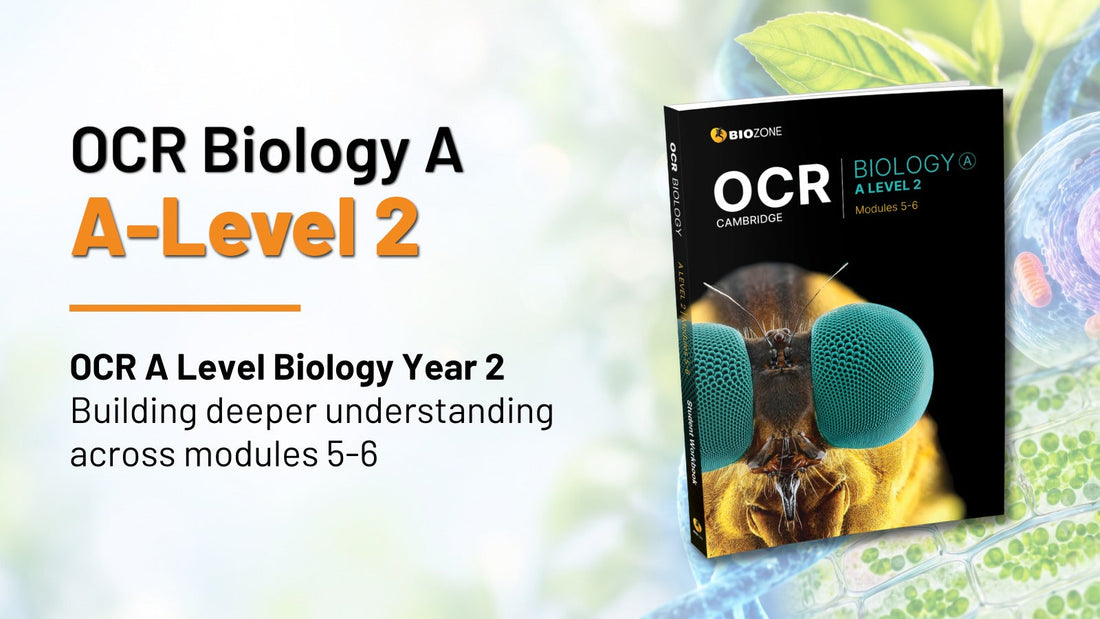
This is where the worktext approach used in BIOZONE OCR Biology A: A-Level 2 becomes particularly relevant.
The resource combines explanatory material with structured activities, encouraging students to engage with concepts while progressing through the content rather than separating reading from practice.
For Year 2 learners, that interaction can be especially useful because so much of the challenge lies in organising and applying knowledge.
HOW BIOZONE OCR BIOLOGY A: A-LEVEL 2 SUPPORTS YEAR 2 LEARNING
BIOZONE OCR Biology A: A-Level 2 is focused on the advanced Year 2 material associated primarily with Modules 5–6.
Its structure reflects several of the learning needs that become increasingly important at this stage.
Two-page module overview spreads include concept maps designed to help students see how ideas within a module connect. This supports a more integrated view before students work through individual topics.
The full-colour presentation provides visual support for complex biological concepts, while structured activities create opportunities to work actively with the subject matter.
The product information also identifies specification-alignment indicators, helping relate activities to relevant areas of the OCR specification. Practical and mathematical skills are integrated into the resource, alongside activities intended to support scientific literacy, data interpretation and critical thinking.
Model answers are provided for worktext questions, offering a reference point for review and self-assessment.
The resource information also refers to QR-linked supporting material, interactive 3D models and an online Resource Hub. BIOZONE WORLD is referenced as part of the wider digital support environment. Because availability and institutional-access arrangements can vary, schools should confirm the current digital options relevant to their intended use.
Taken together, these features position the resource as more than a source of additional Biology information. Its stronger educational role is helping students work with information in structured and connected ways.
WHAT THIS MEANS FOR TEACHERS AND SCIENCE DEPARTMENTS
For teachers, Heads of Science and academic coordinators, selecting a Year 2 resource involves more than checking whether the relevant topics appear in the contents.
The deeper question is whether the resource supports the kind of learning students need at this stage.
Can it help them see connections? Does it provide meaningful opportunities to apply knowledge? Does it integrate skills alongside content? Can it support classroom teaching as well as independent work?
A structured resource can also help departments create greater consistency in the way advanced material is introduced and practised, while teachers retain professional judgement over how it is used within their own programmes.
The most effective role of a resource is not to replace teaching. It is to provide a coherent framework through which teaching, learning, questioning and independent study can interact.
PREPARING STUDENTS TO THINK LIKE ADVANCED BIOLOGY LEARNERS
The real progression in OCR A Level Biology Year 2 is not simply from fewer facts to more facts.
It is from isolated knowledge towards connected understanding.
Students encounter biological communication and regulation, the movement and use of energy, genetic control and inheritance, evolutionary processes, populations and ecosystems. Each area brings its own terminology and detail, but the deeper educational challenge is learning how those ideas relate.
That requires students to interpret information, reason scientifically, work with data, apply mathematical understanding, connect processes and use knowledge in situations that may initially feel unfamiliar.
Resources that support those habits can help make advanced Biology more coherent.
BIOZONE OCR Biology A: A-Level 2 approaches Modules 5–6 through a worktext model that combines explanation, structured activity, visual learning, conceptual connections and skill development. For students, teachers and schools looking for a resource focused on the Year 2 stage of OCR Biology A, that combination provides a useful framework for moving from learning biological content towards actively working with it.