


Environmental science is one of those subjects that can look straightforward at first. Students learn about ecosystems, biodiversity, pollution, energy resources and climate change. But as the course progresses, they soon discover that these topics cannot be studied separately.
A change in land use may affect biodiversity, soil quality and water availability. Energy choices can influence air pollution and climate. Population growth may place additional pressure on food systems, freshwater resources and natural habitats. Even a decision that solves one environmental problem could create a different challenge elsewhere.
This interconnected nature of the subject is what makes AP Environmental Science interesting. It is also what makes the course demanding.
Students are not expected to simply remember environmental terms. They need to interpret scientific information, understand relationships, analyse data and evaluate possible solutions. Choosing an AP Environmental Science textbook that supports these different skills can therefore make a noticeable difference to how students learn throughout the course.
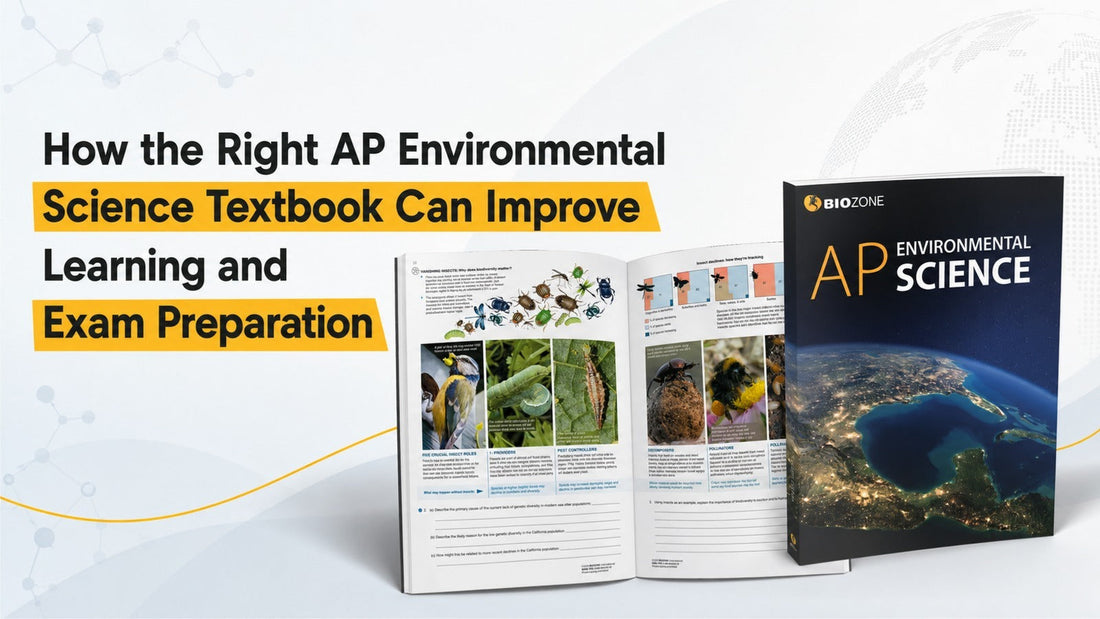
BIOZONE's AP Environmental Science Student Edition has been developed as a visual, activity-based resource for this purpose. It combines concise scientific explanations with case studies, data interpretation, investigations and progress checks. Rather than treating students as passive readers, the book regularly asks them to work with the information in front of them.
Environmental Science Is More Than a Collection of Facts
Memorising a definition of biodiversity is relatively easy. Explaining why biodiversity is declining in a particular ecosystem, identifying the evidence and evaluating a possible conservation response is more challenging.
The same applies to topics such as atmospheric pollution or climate change. Students may remember that certain gases contribute to the greenhouse effect, but AP-level learning requires them to go further. They should be able to examine data, recognise patterns and connect human activity with environmental consequences.
A useful AP Environmental Science textbook should support this progression from knowing a fact to applying it.
BIOZONE's Student Edition follows an interdisciplinary approach. Biological ideas appear alongside concepts from earth science, chemistry, geography and mathematics. Social and economic considerations also enter the discussion when students evaluate environmental decisions.
This reflects how environmental problems actually work. They rarely fit neatly within one scientific category.
Consider freshwater availability. Understanding it may require knowledge of the hydrologic cycle, rainfall patterns, groundwater, agriculture, pollution and population demand. A student who studies each of these ideas in isolation may struggle to explain the larger problem. A connected resource helps them see how one factor influences another.
A Visual Format for Processes That Are Difficult to Imagine
Many environmental processes become easier to understand when students can see them.
Atmospheric circulation, energy flow through an ecosystem, population change and ocean acidification can be difficult to follow through text alone. A clear diagram or graph can show a relationship that would otherwise require several paragraphs to explain.
BIOZONE's AP Environmental Science Student Edition uses a full-colour visual format with photographs, diagrams, maps, tables and graphs. These visual elements are placed alongside explanations and related questions, so they form part of the learning activity rather than being used only as decoration.
For example, students may study a diagram before explaining the movement of matter through an ecosystem. In another activity, they may need to interpret a graph, compare values or identify an environmental trend.
This approach is particularly useful for students who find long, uninterrupted textbook chapters difficult to absorb. The pages divide the content into more manageable sections while still asking students to think carefully.
The visual format can also help during revision. A familiar diagram, annotated process or data set may help a student recall the surrounding concept more quickly than a dense page of notes.
Coverage of the Nine AP Environmental Science Units
The College Board course framework is organised into nine commonly taught units. BIOZONE's Student Edition covers these areas through the following chapter sequence:
-
The Living World: Ecosystems
-
The Living World: Biodiversity
-
Populations
-
Earth Systems and Resources
-
Land and Water Use
-
Energy Resources and Consumption
-
Atmospheric Pollution
-
Aquatic and Terrestrial Pollution
-
Global Change
The book also includes a dedicated chapter on science practices for environmental science students.
This structure gives teachers and students a recognisable path through the course. Early chapters establish important ecological principles before the book moves into population change, resource use, pollution and global environmental challenges.
Chapter introductions provide a summary of the required content. Key questions then give individual activities a clear focus.
That may appear like a small design feature, but it is useful in practice. When students know the question they are trying to answer, they are more likely to read with a purpose. They are not simply moving from one paragraph to another without understanding what matters.
The organisation can also help teachers plan lessons and monitor course coverage. A teacher can select an activity that supports a particular concept or science practice instead of searching through a long narrative chapter for suitable material.
Developing Data-Analysis and Scientific Reasoning Skills
Data is central to environmental science.
Students may be asked to interpret changes in a population, compare pollution levels, calculate resource consumption or evaluate the results of an investigation. They need to understand what the data shows, but also recognise what it does not show.
This skill takes time to develop.
BIOZONE incorporates data-based activities into the subject content. Students encounter tables, graphs and scientific information within environmental contexts rather than learning data analysis as a completely separate topic.
This makes the practice feel more relevant. A graph showing ecological footprints, for example, is not just a mathematical exercise. It can lead to questions about consumption, resource demand, inequality and sustainability.
The book also supports student inquiry through simple laboratory and field-based investigations. Such activities can help students understand how evidence is collected and why variables, methods and reliability matter.
Not every investigation needs complicated equipment. A carefully planned observation or small-scale experiment can still encourage useful scientific thinking. Students learn to ask what is being measured, which factors could affect the outcome and whether the evidence supports the conclusion.
These habits are valuable for the AP examination, but they are also important beyond it. Environmental claims often appear in news reports, advertising, public policy and social media. Students who can examine evidence carefully are better prepared to judge those claims for themselves.
Connecting Course Content With Real Environmental Problems
A textbook can cover every required topic and still feel distant from real life. Environmental science becomes more engaging when students can see how a concept relates to an actual place, event or decision.
BIOZONE's Student Edition uses case studies involving natural and human-made environmental problems. Its global perspective introduces concerns such as wildfires, glacial retreat, pollution, changing ecosystems and biodiversity loss.
Case studies give students something concrete to investigate.
Instead of only memorising a definition of habitat loss, they can consider what caused the loss, which organisms or communities are affected and what response may be practical. They may also discover that environmental solutions involve trade-offs.
Hydroelectric power provides one example. It can generate electricity without burning fossil fuels at the point of production, but a dam may alter river flow, affect fish movement and change nearby habitats. A serious environmental analysis needs to consider both the benefits and the costs.
The same is true of many land-use, energy and conservation decisions. There may not be a single perfect answer.
By working through such examples, students learn to avoid oversimplified conclusions. They begin to ask better questions: What evidence is available? Who or what is affected? Is the proposed solution realistic? Could it create an unintended consequence?
That is a more mature way of approaching environmental science.
Progress Checks That Support Exam Preparation
Effective AP exam preparation should not begin only when the course is almost over.
Students benefit from checking their understanding throughout the year. If a learner has difficulty interpreting population graphs, it is better to identify that early rather than discovering it during final revision.
BIOZONE includes personal progress checks that provide opportunities for formative assessment. These checks can help students identify strong areas as well as topics that need further work.
Concept and science-practice codes also appear across the program. They help students recognise the type of thinking used in an activity, whether that involves explaining a concept, analysing a visual representation, interpreting data or evaluating a solution.
The College Board identifies seven science practices for the course:
-
Concept explanation
-
Visual representation analysis
-
Text analysis
-
Scientific experiment analysis
-
Data analysis
-
Mathematical routines
-
Environmental solutions
Regular exposure to these practices can make exam preparation more gradual. Students are not meeting analytical questions for the first time at the end of the course. They have already practised similar thinking within individual topics.
Of course, no textbook can guarantee an examination result. Student effort, teaching quality, consistent revision and practice remain important. A well-designed resource can, however, make that preparation better organised and more closely connected to the course skills.
A Worktext Approach Rather Than Passive Reading
BIOZONE describes this resource as a worktext, combining features of a textbook and workbook.
That distinction matters.
In a conventional textbook, students may read a section and then complete separate questions elsewhere. In a worktext, the explanation, visual material and student response are brought together more closely.
Students can examine information and respond within the same learning sequence. Their completed work also becomes a record of how their understanding has developed.
This format may be particularly useful for students who learn best by doing something with the information. Reading is still important, but it is followed by interpretation, calculation, explanation or evaluation.
Teachers can also see more than whether a chapter has been read. Student responses can reveal misconceptions and show where additional explanation may be needed.
Print and Digital Learning Options
The AP Environmental Science Student Edition is a 372-page, full-colour paperback. It is the first edition, published in 2020, and was developed for the College Board's 2019 AP Environmental Science Course and Exam Description with the 2020 amendments.
BIOZONE also provides digital and teacher-support resources. The exact availability, licensing requirements and package contents should be confirmed before purchase, especially for institutional orders.
Depending on the selected arrangement, BIOZONE WORLD may provide an interactive digital replica of the book. Students can access activities, enter answers and submit work to their teacher. Supporting resources may include presentation slides, curated videos, 3D models and weblinks.
A Resource Hub is also available with selected open educational materials supporting the worktext.
These options can help schools combine printed classroom work with digital access. However, they should not be assumed to be included automatically with every individual book purchase. Schools should confirm the applicable access conditions, minimum quantities and licence duration while placing an order.
Who Is the Book Suitable For?
The Student Edition may be useful for students taking AP Environmental Science, teachers seeking an activity-led course resource and schools evaluating structured AP science materials.
It may particularly suit learners who:
-
Prefer visual explanations to long passages of uninterrupted text
-
Need more regular practice with graphs and environmental data
-
Benefit from guided questions and clearly focused activities
-
Want to connect scientific concepts with real environmental cases
-
Need a structured record of learning and revision
Parents looking for a supporting resource should remember that the book is designed around the AP course framework. It is not simply a general introduction to environmental awareness. Its activities expect students to engage with scientific ideas, evidence and analysis.
Helping Students Think Like Environmental Scientists
The value of AP Environmental Science extends beyond learning the names of ecosystems or sources of pollution.
Students learn how natural systems are connected, how human activities influence those systems and why environmental decisions can be complicated. They also learn that a persuasive claim is not necessarily a scientifically reliable one. Evidence has to be examined.
BIOZONE's AP Environmental Science Student Edition supports this learning through visual explanations, connected course content, investigations, case studies, data analysis and progress checks.
For students, it can make a broad and demanding subject more manageable. For teachers, it offers a practical way to combine course knowledge with science practices. For schools, it provides a structured resource that encourages participation rather than passive reading.
A suitable AP Environmental Science textbook should not merely tell students what is happening in the natural world. It should help them ask why it is happening, examine the evidence and consider what could realistically be done about it.
https://biozoneasia.com/products/ap-environmental-science-student-edition