


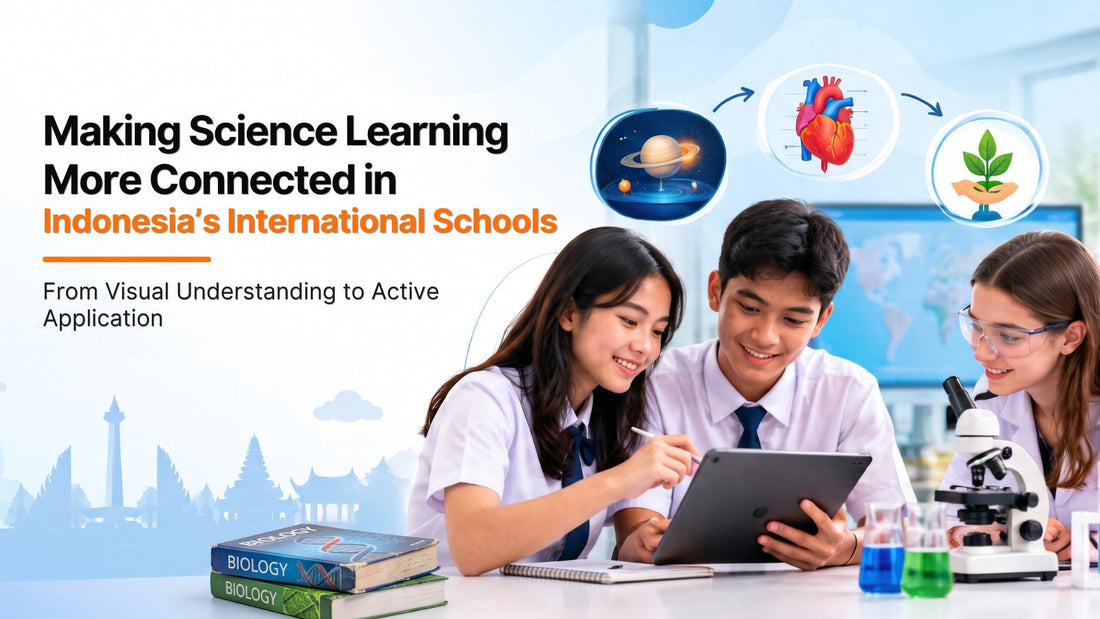
A student can look at a diagram of a cell, read the labels and remember the definition of each structure. But can that student explain how those structures work together, interpret a new image, compare two cell types or apply the idea in an unfamiliar question?
That difference—between seeing information and using it—is one of the most important challenges in science learning.
In Indonesia’s international-school environment, the question is especially relevant because students may encounter visually rich, concept-heavy science programmes that expect more than recall. The International Baccalaureate currently lists 81 IB World Schools in Indonesia, with 58 offering the Diploma Programme. That figure provides useful context, but the more important issue for schools is how students actually engage with the science they are taught.
Strong science learning does not happen simply because a page contains attractive diagrams or because a digital platform includes animations. Visual material becomes educationally valuable when students are asked to work with it.
The goal is therefore not just to make science more visual. It is to make visual understanding part of an active learning sequence:
-
See
-
Understand
-
Question
-
Interpret
-
Apply
For schools evaluating science resources for international schools in Indonesia, this sequence offers a practical way to distinguish between content that looks engaging and content that genuinely asks students to think.
Visuals Should Do More Than Decorate the Page
Science is naturally visual.
Biology uses diagrams to show structures, cycles, relationships and processes that cannot always be observed directly. Graphs show patterns that may be difficult to recognise in raw numbers. Microscopy images reveal details beyond normal vision. Models help students reason about systems that are too small, too large, too fast or too slow to experience directly.
Yet a visual does not automatically create understanding.
A labelled diagram can still be studied passively. A student may memorise what each label points to without understanding why the structures matter or how they relate to one another.
A better resource turns the visual into part of the task.
Students might annotate a process, predict what happens when one part changes, compare two structures, identify a pattern in a graph, connect an image to experimental data or explain what evidence supports a conclusion.
Those actions transform a picture from something to look at into something to think with.
For Biology in particular, that distinction is important because many topics involve relationships: structure and function, cause and effect, regulation, exchange, inheritance, variation and interaction within systems.
From ‘I Recognise It’ to ‘I Can Explain It’
Recognition can create a false sense of confidence.
A student sees a familiar diagram and thinks, “I know this.” But when the labels are removed, the image is redrawn from another angle or the same principle appears in a new context, the understanding may be less secure than it seemed.
Good learning resources help students move beyond recognition.
After introducing a concept visually, they should encourage learners to explain it in their own words, connect it to prior knowledge and identify what the visual actually shows.
Useful prompts might ask:
-
What relationship is shown here?
-
Which feature is most important to the process?
-
What would change if one variable increased?
-
How does this structure support its function?
-
What evidence in the graph supports the conclusion?
-
How is this example similar to, or different from, the previous one?
These are not difficult questions because they use complicated language. They are useful because they make the learner process the information rather than merely recognise it.
Connect Explanation and Activity More Closely
One reason science learning can become fragmented is that explanation and activity are often separated.
Students may read several pages of content and only later move to a worksheet. The connection between what they have just learned and what they are being asked to do may not always be obvious.
Interactive science learning resources can reduce that distance.
When a question, data set, diagram or short activity appears close to the concept it develops, students can act on the information while it is still active in their thinking.
This creates a more natural rhythm:
-
Learn a concept
-
Use the concept
-
Check what is understood
-
Identify a gap
-
Return to the explanation if needed
-
Continue to the next level of application
That rhythm can be particularly useful in science because concepts are often cumulative. A misunderstanding in one section can make later material much harder.
Resource design cannot prevent every misunderstanding, but it can make it easier for students and teachers to notice where understanding starts to break down.
Data Interpretation Is a Bridge Between Visual Learning and Scientific Thinking
Graphs, tables and experimental results are among the most important forms of visual information in science.
They also provide a strong bridge between seeing and applying.
A student who reads a graph title but does not examine the axes, units, scale or pattern has not really used the data. A student who can describe the pattern but cannot explain its biological significance has only completed part of the task.
Good science resources should therefore help students practise several layers of data interpretation:
-
identify what the data represent
-
recognise patterns or trends
-
compare values or conditions
-
calculate where appropriate
-
connect the pattern to a scientific concept
-
evaluate whether the evidence supports a conclusion
-
recognise limitations or alternative explanations where relevant
This kind of practice is valuable beyond a single assessment. It develops habits of evidence-based thinking.
For international schools, that matters because many international science programmes expect learners to work with information they have not seen in exactly the same form before.
Structured Questions Can Build Application Gradually
Application does not have to begin with the hardest possible problem.
In fact, a well-designed learning sequence often moves from relatively direct questions towards more unfamiliar tasks.
Early questions can confirm that students understand the vocabulary and central concept. The next stage can require interpretation, comparison or explanation. Later questions can combine ideas, introduce data or ask students to apply the concept in a new situation.
This progression helps students build confidence without confusing confidence with ease.
If every question simply repeats what was written in the paragraph above, students may complete a large amount of work without developing much transfer.
On the other hand, if every question immediately demands complex synthesis, students may struggle to identify which part of their understanding needs improvement.
Strong interactive biology workbooks and worktext-style resources can create a better progression by mixing direct understanding, visual interpretation, data use and application.
Make the Student an Active Participant
The word ‘interactive’ is sometimes used to mean digital.
But interaction is fundamentally about what the learner does.
A printed resource can be highly interactive if students are constantly asked to annotate, calculate, draw, interpret, compare, explain and apply. A digital resource can still be passive if the student mostly scrolls, watches and clicks through content.
For schools, this is a useful distinction.
Instead of asking only whether a resource is digital or whether it contains multimedia, ask:
-
What will the student actually do with this material?
-
Will the learner make decisions?
-
Will they record reasoning?
-
Will they interpret evidence?
-
Will they have to explain relationships?
-
Will the activity reveal misunderstanding?
-
Can the student revisit the work later and see how their thinking developed?
These questions move resource evaluation away from format and towards learning behaviour.
Teacher Usability Still Matters
Active learning works best when the resource supports the teacher rather than creating another layer of preparation.
Teachers already decide how much guidance a class needs, which examples to emphasise, when to pause for discussion, how to support different learners and how to connect classroom activity with assessment expectations.
Science teaching resources in Indonesia’s international schools should therefore be evaluated from the teacher side as well as the student side.
Useful resources may provide clear sequencing, well-designed diagrams, activity prompts, data tasks, model answers or teacher guidance, and supporting digital materials where these are available for the relevant title.
The aim is not to automate teaching.
It is to give teachers strong, usable material that can be adapted intelligently to the class in front of them.
When a resource already brings explanation and activity together coherently, teachers can spend more time on questioning, feedback, practical work and discussion rather than recreating every supporting worksheet from the beginning.
Independent Study Needs the Same Learning Logic
A connected science resource should remain useful when students are studying without immediate teacher support.
At home, students need to recognise where a topic begins, understand what the visual material is showing, know what they are expected to do and identify when they need to return to an earlier explanation.
This is another reason why the sequence from visual understanding to active application matters.
A resource that simply presents information may be easy to read but difficult to learn from independently.
A resource that combines explanation, visual cues, structured activity and review gives students more ways to test their own understanding.
They can ask:
-
Can I explain this process without copying the wording?
-
Can I interpret the diagram without the labels?
-
Can I use the concept with a different example?
-
Can I make sense of the data?
-
Do I understand why my answer was wrong?
That kind of self-check can make independent study more purposeful and can help classroom learning continue beyond the lesson.
Print and Digital Can Reinforce the Same Learning Journey
Indonesia’s international schools may use different combinations of print and digital learning depending on curriculum, infrastructure, institutional preferences and the resources available for a particular programme.
The important question is not which format is automatically better.
It is whether the formats support the same learning journey.
Print can provide a focused place for explanation, annotation, written responses and a permanent record of student work. Digital resources can extend selected topics through videos, animations, 3D models, web links, interactive activities or teacher workflow features where those options are available.
The two formats are strongest when they reinforce each other.
For example, a student might study a diagram in print, use a digital model to explore the same structure from another perspective, return to the worktext to answer questions and later review the written response before an assessment.
Schools should confirm the digital support and licensing available for each specific title and institutional arrangement. Digital access should not be assumed to be identical across every resource.
A Practical Review Framework for Schools
When evaluating biology resources for international schools in Indonesia, academic teams can use a simple set of questions:
-
Curriculum fit: Does the resource match the programme, level and syllabus being taught?
-
Visual quality: Do diagrams, graphs and images clarify scientific relationships rather than simply add colour?
-
Active use: Are students regularly asked to annotate, interpret, compare, calculate, explain or apply?
-
Progression: Do questions move from understanding towards more demanding application?
-
Data and evidence: Are learners given meaningful opportunities to work with scientific data and evidence?
-
Teacher usability: Can the material support classroom explanation, homework, feedback and revision without excessive reconstruction?
-
Independent learning: Can students navigate and use the resource effectively outside direct instruction?
-
Print-digital continuity: Where digital support exists, does it extend the same learning sequence?
-
Practicality: Are format, access, licensing and institutional-use conditions clear?
This framework helps schools evaluate the learning experience behind the resource, not just its page count, design or product description.
Where BIOZONE Fits
BIOZONE’s interactive worktext model is designed around the principle that students should interact with science rather than only read about it.
The worktext combines highly visual explanatory content with workbook-style activities so that diagrams, data, questions and student responses sit close to the ideas they develop.
For international schools exploring BIOZONE Asia, this approach can be considered across programme-specific science resources including Biology, IB Biology and Cambridge International Biology.
The value is not that every title looks or functions identically. Different programmes require different curriculum alignment and different learning emphases.
The consistent principle is that scientific information should lead into student action: interpret, annotate, calculate, explain, compare, apply and review.
BIOZONE’s current global teacher-support ecosystem also includes resources such as Teacher’s Editions and Resource Hub materials, while BIOZONE WORLD brings together digital student editions and teacher functions for applicable institutional programmes. Availability, licensing and access should be confirmed for the specific title and market before adoption.
For schools in Indonesia considering BIOZONE resources as part of a wider resource evaluation, the key question is therefore not simply how much content a book contains..
It is how effectively the resource helps students work with that content.
Connected Science Learning Begins With What Students Do
Science becomes more meaningful when learners move beyond recognising information and begin using it.
A diagram should lead to interpretation.
A graph should lead to evidence.
An explanation should lead to a question.
A question should reveal understanding.
A mistake should lead back to the concept.
And a familiar idea should eventually be usable in an unfamiliar situation.
For international schools in Indonesia, this provides a practical standard for evaluating science resources across different programmes and formats.
The strongest resource is not necessarily the one with the most pages, the most digital features or the most visually impressive design.
It is the one that creates a clear path from seeing to understanding, from understanding to questioning, and from questioning to application.
That is how visual science learning becomes connected science learning.
Explore BIOZONE Science Learning Resources
International schools and educators in Indonesia can explore BIOZONE Asia’s programme-specific science resources and learning solutions for classroom teaching, active learning and independent study.
Explore BIOZONE Asia: