


A Biology resource can match a syllabus on paper and still be difficult to teach from.
The chapters may be in the right order. The terminology may be familiar. The content may appear complete. Yet once the resource reaches the classroom, teachers can discover that students need more explanation, more practice, better visual support or stronger opportunities to apply what they have learned.
For international schools teaching Cambridge International AS & A Level Biology, that distinction matters.
The current Cambridge Biology syllabus places emphasis not only on knowledge, but on understanding concepts, applying biological ideas in unfamiliar contexts and developing advanced practical skills. A strong learning resource therefore has to do more than help a department tick off topics.
It needs to help students learn Biology in the way the course expects them to think about Biology.
Curriculum Alignment Is the First Filter, Not the Final Decision
Any resource review should begin with syllabus relevance.
Schools need to know whether the material supports the correct Cambridge programme, syllabus stage and level of depth. Learning outcomes, subject coverage and progression should be easy for teachers to identify.
But alignment is only the entry point.
Two resources can cover similar content and still create very different learning experiences. One may mainly present information. Another may combine explanation with questions, visual interpretation, data work and opportunities to apply concepts.
For Cambridge Biology, the second approach can be especially valuable because the course explicitly expects students to move beyond recall.
When reviewing Cambridge AS and A Level Biology resources, schools should therefore ask both:
-
Does this resource cover what we need to teach?
-
Does it help students practise how they will need to think?
Look for Understanding Before Volume
More content does not automatically make a Biology resource stronger.
Dense pages can create an impression of academic depth while leaving students unsure about the relationships between ideas. At the other extreme, an over-simplified resource may feel accessible but fail to develop the depth needed for advanced study.
The better target is clarity with intellectual substance.
Students should be able to understand the core idea, see how it connects with earlier learning and then do something with it.
That might involve explaining why a process occurs, comparing two biological systems, interpreting a graph, analysing experimental evidence or applying a familiar concept to a new situation.
A strong Cambridge Biology workbook or learning resource should therefore make the progression from knowledge to application visible.
Visuals Should Help Students Think, Not Simply Decorate the Page
Biology depends heavily on visual understanding.
Cells, membranes, transport processes, biochemical pathways, genetics, physiology and ecosystems all involve structures and relationships that are often easier to grasp when students can see them.
But the presence of diagrams is not enough.
Schools should look at what students are expected to do with those diagrams.
Can they annotate them? Compare them? Use them to explain a process? Connect them with data? Identify a relationship that is not stated directly in the text?
When visual material becomes part of the task, it moves from presentation into learning.
This is particularly useful in an advanced Biology course where students must become comfortable reading unfamiliar representations rather than relying only on diagrams they have memorised.
Practical Skills Need a Place in the Resource Strategy
Cambridge International AS & A Level Biology gives practical work a significant role. Cambridge states that the syllabus has a strong emphasis on advanced practical skills, and practical skills are assessed through a timetabled practical examination.
That means a school's resource strategy should not separate theory completely from practical thinking.
A book cannot replace laboratory work, nor should it try to.
But it can help students understand the reasoning that surrounds practical science.
Useful activities may ask students to:
-
identify variables and controls
-
interpret experimental results
-
evaluate the quality of evidence
-
recognise limitations
-
draw conclusions from data
-
predict how changing a variable may affect an outcome
-
connect an investigation with the biological concept it demonstrates
When those habits are developed alongside content learning, practical work becomes part of scientific understanding rather than an isolated laboratory exercise.
Questions Should Reveal How Students Are Thinking
Question quantity can be misleading.
A resource may contain hundreds of questions but still rely heavily on short recall.
For advanced Biology, a better question is whether the activities vary in purpose.
Students need some questions that establish knowledge. They also need questions that expose whether they can use that knowledge.
A useful mix may include:
-
concept explanation
-
data interpretation
-
experimental reasoning
-
comparison of biological processes
-
application in unfamiliar contexts
-
evaluation of evidence
-
structured written explanations
The strongest questions also help teachers see where a student is struggling.
An incorrect response may indicate a content gap, a misunderstanding of the command word, weak data interpretation or difficulty connecting evidence with a conclusion. Those are different problems and require different teaching responses.
Students Should Be Able to Use the Resource Without the Teacher Beside Them
Cambridge Biology students spend a substantial amount of time outside direct classroom instruction.
They complete homework, prepare for practical work, revisit difficult concepts and eventually revise for examinations.
A resource becomes more valuable when students can navigate it independently.
Clear learning outcomes, logical sequencing, visual explanations, structured questions and review opportunities can help students understand what they are expected to know and what they still need to practise.
This does not remove the role of the teacher.
It means the resource continues to support the learning process after the lesson ends.
For international schools, this continuity is important. A resource that works in class, for homework and during revision can create a more coherent academic journey than a collection of disconnected notes, worksheets and websites.
Teacher Usability Is Part of Academic Quality
A resource should also be judged from the teacher's side of the desk.
Cambridge Biology teachers need to plan sequences, explain demanding concepts, organise practical work, assign homework, check understanding, prepare assessment and support students at different levels of confidence.
The most useful A Level Biology teaching resources give teachers something practical to work with.
Schools can look for:
-
clear links between learning outcomes and student activities
-
model answers or guidance where appropriate
-
questions that can be used for classwork, homework or review
-
supporting visual or digital material
-
teacher notes or classroom guidance
-
additional assessment support
-
resources that can be adapted without rebuilding the course from scratch
Teacher support should not turn lessons into a fixed script. It should reduce unnecessary reconstruction and leave more room for professional judgement.
Check the Syllabus Year, Not Just the Programme Name
One practical point deserves particular attention when schools evaluate Cambridge International Biology books.
Cambridge revises its qualifications periodically. The current AS & A Level Biology 9700 page lists a 2025–2027 syllabus and a 2028–2030 syllabus. Cambridge also notes that updates can clarify learning outcomes, move or change content and revise assessment details.
For this reason, a resource should not be selected simply because the cover says “Cambridge Biology” or “A Level Biology”.
Schools should confirm:
-
which syllabus years the resource was designed to support
-
whether the content map reflects the current programme being taught
-
whether practical and assessment expectations remain appropriate
-
whether any newer syllabus changes need supplementary teacher planning
This is a sensible check for any publisher or resource provider, including BIOZONE.
A Practical Checklist for International Schools
When a Head of Science or Biology department compares Cambridge Biology learning resources, the following questions can help structure the decision.
1. Is the resource clearly matched to the correct Cambridge Biology level?
Teachers should be able to identify how the content relates to AS, full A Level and the relevant syllabus year.
2. Does it develop understanding as well as knowledge?
Look for explanations and activities that help students connect ideas instead of simply collecting facts.
3. Does it support application in unfamiliar contexts?
Students should have regular opportunities to use biological ideas rather than only repeat them.
4. Are practical and data skills visible?
The resource should support the reasoning that surrounds investigation, evidence and analysis.
5. Are visuals academically useful?
Diagrams, models and graphs should contribute to understanding and ideally become part of the task.
6. Can students use it independently?
Homework and revision should feel like a continuation of learning rather than a separate system.
7. Does it support the teacher?
Teacher guidance, answers, assessment material and digital support should connect with the student resource.
8. Can the department use it consistently across the course?
A strong resource should provide enough structure to support continuity while still allowing teachers to adapt.
Where BIOZONE Fits Into Cambridge Biology Learning
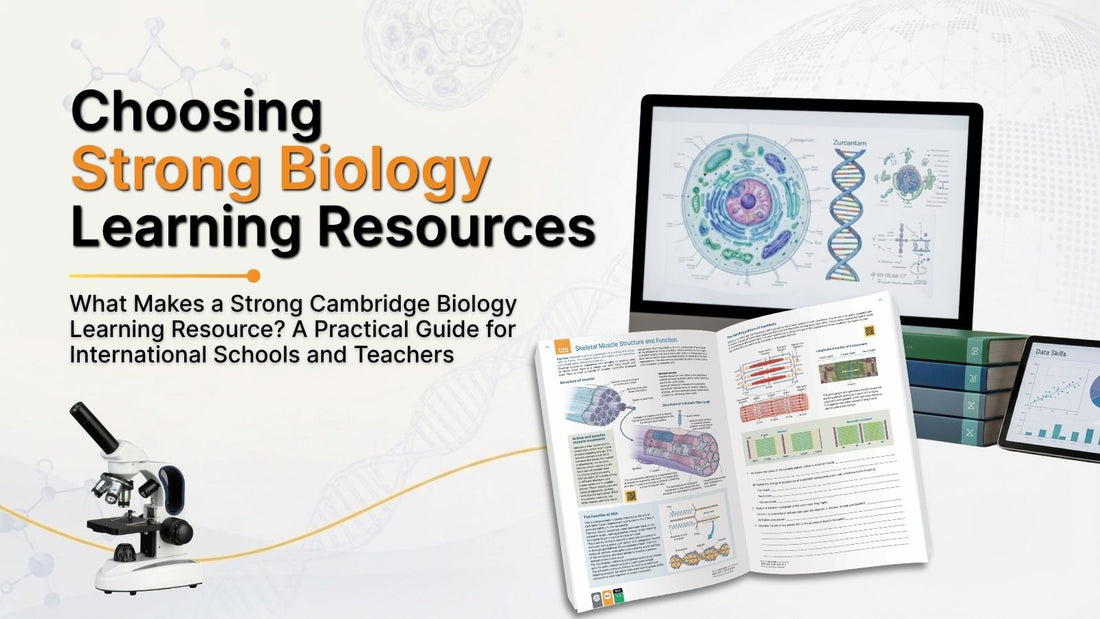
BIOZONE's CIE Biology resources use an interactive worktext approach that combines biological explanations, clear visual material, targeted learning outcomes, questions and activities within the same learning context.
The current BIOZONE programme information positions CIE Biology 1 for Cambridge International AS Biology and CIE Biology 2 for the second year of the full A Level course. Together, the resources are designed to support the Cambridge International AS and A Level Biology programme.
BIOZONE also describes the CIE resources as suitable for classroom use, homework, independent study, review, examination preparation and extension. Features include specification mapping, scaffolded learning, varied activities and chapter review opportunities.
Teacher support is available around the programme as well. Depending on the title and access arrangement, BIOZONE lists resources such as Classroom Guides, model answers, additional assessment tasks, teacher notes, editable question libraries, Resource Hub material and digital teacher functionality through BIOZONE WORLD.
As with any Cambridge resource, schools should confirm the suitability of the specific BIOZONE title against the syllabus year they are teaching and verify current regional availability, purchase conditions and digital-access arrangements before adoption.
The value of the approach is therefore not simply that students receive another Biology book.
It is the possibility of giving teachers and students a more connected resource in which explanation, visual learning, application and question work can sit together.
The Right Resource Should Make the Course Easier to Learn, Not Easier in Difficulty
A strong Cambridge Biology resource should not reduce the academic challenge of the subject.
It should make that challenge clearer to navigate.
Students still need to understand difficult ideas. They still need to work with evidence, develop practical skills, interpret data and communicate biological reasoning.
Teachers still need to make professional decisions about pacing, practical work, feedback and assessment.
The role of a good resource is to support those demands with structure.
When schools select materials on that basis, the decision moves beyond asking whether a book contains the syllabus.
The better question becomes:
Will this resource help our students understand, apply and revisit the Biology they are expected to learn?
That is a more demanding standard—but it is also a more useful one.
Explore BIOZONE Cambridge Biology Resources
International schools and educators can explore BIOZONE Asia's Biology solutions and Cambridge/CIE resource options for classroom teaching, independent study and institutional use.
Explore BIOZONE Asia Biology Solutions: