


For an international school choosing new science resources, one question usually comes first:
Does this resource cover the curriculum?
It is an essential question. Schools need confidence that the books, workbooks and supporting materials they select are relevant to the programme being taught and capable of supporting its academic requirements.
But curriculum coverage alone does not tell the whole story.
A resource can contain all the expected topics and still be difficult for students to use effectively. It may explain concepts accurately but offer too little opportunity to apply them. It may provide plenty of information while giving teachers limited support in turning that information into meaningful classroom learning.
That is why selecting science resources deserves a broader conversation.
The more useful question may be:
Does this resource simply cover the curriculum, or does it help students actively learn it?
For international schools, where students may be working through demanding programmes and preparing for assessments that expect understanding, interpretation and application rather than simple recall, the distinction matters.
The right science resources should support the curriculum, certainly. But they should also help teachers teach, help students think, and create a practical bridge between classroom instruction, independent study and assessment preparation.
Curriculum Alignment Is the Starting Point
Curriculum alignment should never be treated as unimportant.
Whether a school follows an international programme in biology, environmental science or another science discipline, teaching teams need resources that correspond appropriately with what students are expected to learn.
A good initial review should therefore consider questions such as:
-
Does the material address the relevant concepts and subject areas?
-
Is the level of scientific depth appropriate?
-
Does the structure make sense within the teaching programme?
-
Can teachers use the material alongside their existing curriculum planning?
-
Does the resource provide suitable support as students progress towards assessments?
These questions help establish whether a resource belongs on the shortlist.
But they should not be the final selection criteria.
A curriculum tells a school what students need to learn. A learning resource also needs to help answer how students are going to understand, practise and apply it.
That is where the quality of resource design becomes much more important.
Moving Students Beyond Passive Reading
Science is difficult to learn effectively as a collection of facts.
A student can read a description of cellular respiration, genetics, ecological relationships or experimental design and feel that the material makes sense. The real test comes later, when that student needs to explain the concept, interpret unfamiliar data, analyse a diagram or apply knowledge in a different context.
This gap between recognising information and being able to use it is one of the reasons active engagement matters.
When schools evaluate science books and learning resources, they should therefore look beyond the amount of information provided.
A strong resource should create regular opportunities for students to do something with what they are learning.
That may involve:
-
interpreting a graph
-
analysing an illustration
-
completing a labelled diagram
-
comparing scientific processes
-
working through a data set
-
answering structured questions
-
drawing a conclusion from evidence
-
connecting one concept with another
-
applying knowledge to a new situation
-
reviewing their own understanding
These activities change the student's role.
Instead of simply receiving information, the student becomes an active participant in the learning process.
For science education in particular, that is an important difference.
Student Engagement Is More Than Making a Page Look Interesting
The word engagement is sometimes reduced to colourful pages, digital effects or short attention-grabbing activities.
Those things may contribute to presentation, but meaningful academic engagement goes deeper.
A student is genuinely engaged when the resource encourages them to observe, question, interpret, connect, reason and respond.
Good science learning resources should therefore make complex information approachable without oversimplifying the science.
Visual presentation can help. Diagrams, photographs, models, tables, flow charts and well-designed illustrations can make difficult relationships easier to see.
But visual elements work best when students are encouraged to interact with them.
A diagram that is simply looked at may help explain a concept.
A diagram that students need to interpret, annotate, compare or use to answer a question can become part of the learning itself.
The same principle applies to data.
Charts and experimental results should not always be decorative additions. They can help students practise the kind of scientific interpretation and reasoning they are likely to need both in the classroom and during formal assessment.
For schools comparing different science resources for international schools, this is worth examining closely.
Ask not only:
What information is included?
Also ask:
What does the student have to do with this information?
Can Students Use the Resource Independently?
Classroom time is only one part of the learning journey.
Students also work outside formal lessons. They complete assignments, revisit concepts they did not fully understand, prepare for assessments and revise independently.
A resource that works well only when a teacher is continuously explaining it may have limited value once the student leaves the classroom.
Schools should therefore consider whether their science resources support a reasonable degree of independent learning.
Students should be able to navigate the material without unnecessary confusion. Explanations should be structured logically. Illustrations should contribute to understanding. Activities should help them reinforce concepts, and opportunities for review should allow them to recognise where further study may be needed.
This becomes particularly important for students preparing for demanding international examinations.
Effective revision is not simply rereading pages several times. Students need opportunities to retrieve knowledge, apply ideas, interpret information and identify gaps in their understanding.
A well-designed learning resource can support this process throughout the year rather than becoming useful only when examinations are approaching.
What Does the Resource Ask Students to Think About?
One useful way for a school to evaluate a science resource is to open it at several different points and examine the questions being asked.
Are students mainly completing simple recall tasks?
Or are they also being asked to interpret, analyse and apply?
Recall has its place. Students need scientific vocabulary, factual knowledge and a clear understanding of core principles.
However, a resource built almost entirely around remembering information may not sufficiently support higher-level scientific thinking.
Look for a mixture of activities that encourage students to:
-
explain scientific ideas in context
-
recognise patterns
-
work with evidence
-
interpret experimental findings
-
understand cause and effect
-
analyse biological or scientific relationships
-
evaluate information
-
solve unfamiliar problems
This does not mean every activity must be difficult.
Good learning design often builds progressively. Students first establish understanding and then use that understanding in more challenging ways.
That progression can make science feel more manageable while still maintaining academic depth.
The Teacher's Experience Matters Too
Students are not the only users of school learning resources.
Teachers need to integrate materials into actual lessons, homework, revision, assessment preparation and differentiated classroom situations.
A resource may be academically strong but still create difficulties if teachers have to spend considerable time reorganising or supplementing it before it becomes practical to use.
When evaluating science teaching resources for schools, academic departments should therefore ask:
-
Is the content organised in a way that teachers can work with?
-
Can activities be incorporated into lessons without excessive preparation?
-
Can sections be assigned for homework or independent practice?
-
Does the resource complement teacher-led explanation?
-
Are there opportunities for review and reinforcement?
-
Can it support students working at different levels of confidence?
-
Are useful teacher resources available alongside the student material?
Teachers will always bring their own professional judgement and classroom approach. No book should attempt to replace that.
The better question is whether the resource gives teachers a stronger starting point and useful tools to work with.
When resources support both the teacher and the learner, they can become part of the teaching process rather than simply another book that students carry.
One Resource Does Not Need to Do Everything
Schools sometimes approach resource selection as though one book must solve every teaching and learning requirement.
That may not be realistic.
A print resource may be particularly useful for structured classroom activity, annotation and focused study. Digital science resources can extend learning through additional activities, videos, visual material, online interaction or other supporting experiences where available.
Teacher-developed material will also remain important.
So will practical laboratory work, discussion, investigation and wider reading.
The goal is not necessarily to find a single resource that replaces everything else.
It is to create a coherent learning environment in which different resources work together rather than creating unnecessary fragmentation.
This is why schools may benefit from considering both print and digital science resources as parts of the same learning journey.
The key question becomes:
Does each resource have a clear role, and can students move between those resources without losing continuity in their learning?
Consider the Full Academic Year, Not Just the Purchase Decision
Another useful test is to imagine how the resource will actually be used over an entire academic year.
At the beginning of a topic, could it help students establish the key concepts?
During teaching, could activities reinforce classroom explanation?
After the lesson, could students use it independently?
Before an assessment, could they revisit earlier material and test their understanding?
During revision, could they identify weaker areas rather than simply reread everything?
A resource that contributes at several stages of this cycle can provide much greater educational value than one designed primarily for occasional reference.
This is also where structured student workbooks and interactive science learning resources can play an important role.
The more frequently students meaningfully interact with a resource, the more likely it is to become part of their learning routine rather than simply something kept on a shelf.
Avoid Choosing Resources on Familiarity Alone
Schools often have established resource lists, publisher relationships and departmental preferences. Continuity can be valuable, and changing learning materials without good reason can create unnecessary disruption.
At the same time, resource selection should not become automatic.
Science education evolves. Curricula change. Digital learning develops. Student expectations shift, and teaching teams gain new insight into what works well in their classrooms.
Periodic resource review gives schools an opportunity to ask whether existing materials still serve students as effectively as they could.
That does not mean chasing every new educational trend.
It means being willing to compare resources thoughtfully.
A familiar textbook may remain the right choice.
A different combination of textbook, workbook, interactive worktext, teacher resource and digital support may prove more useful.
The decision should follow the educational need.
A Practical Resource-Selection Framework for Schools
When Heads of Science, curriculum coordinators or academic teams compare new science resources, the following framework can help organise the discussion.
1. Curriculum Relevance
Does the resource appropriately support the curriculum or programme being delivered?
2. Scientific Quality
Is the material presented at an appropriate level of depth and clarity?
3. Student Interaction
Are students regularly required to apply, interpret or work with the content?
4. Visual Communication
Do diagrams, figures, photographs and data presentations genuinely help explain scientific ideas?
5. Classroom Usability
Can teachers integrate the resource naturally into teaching rather than constantly reworking it?
6. Independent Learning
Can students use the material confidently outside the classroom?
7. Assessment Support
Does the resource help students practise the skills and understanding required for assessment without reducing learning to test drilling?
8. Teacher Support
Are appropriate resources available to support planning, explanation, review and classroom use?
9. Print and Digital Continuity
Where both formats are used, do they complement rather than duplicate or fragment the learning experience?
10. Student Engagement
Most importantly, does the resource encourage students to think about science rather than simply read about it?
This final question can reveal a great deal.
Where BIOZONE Fits Into This Conversation
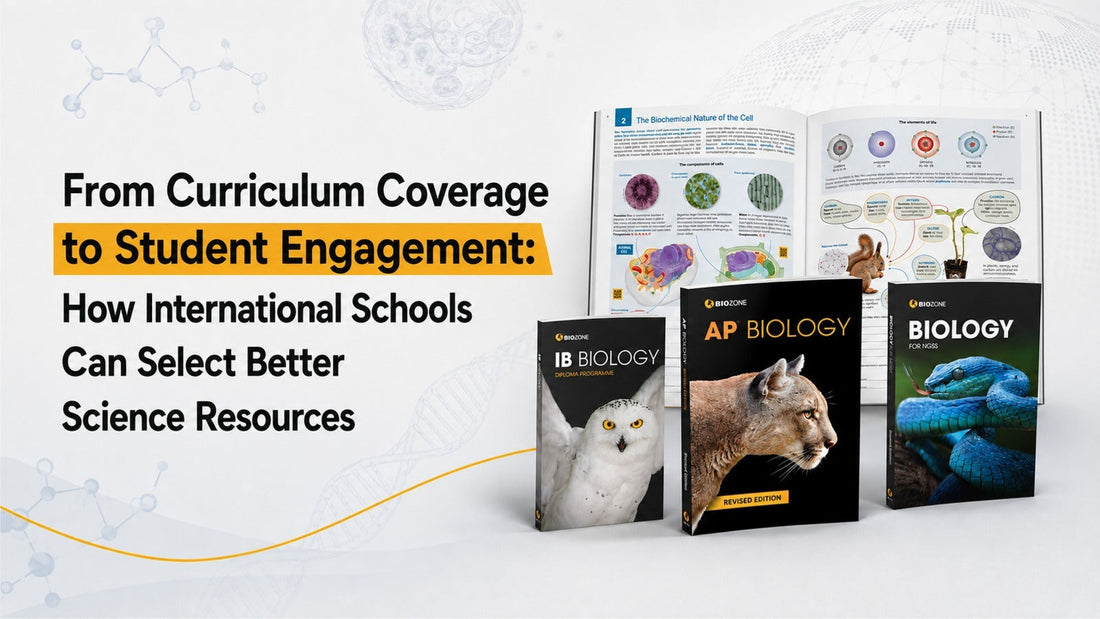
BIOZONE develops science learning resources around an interactive approach in which students engage directly with scientific concepts through explanations, visual material, questions and learning activities.
For international schools evaluating science books and teaching resources, this approach offers an alternative to relying entirely on conventional information-heavy textbooks.
BIOZONE resources span areas including biology and other science disciplines, with student, teacher, print and digital learning options available across relevant programmes and subjects.
The aim is not simply to provide students with more pages to read.
The broader value lies in creating structured opportunities for students to work with scientific ideas—whether in the classroom, through assigned activities, during independent learning or while preparing for assessments.
For teachers and academic teams, this means BIOZONE can be considered not only as a publisher of individual books but as part of a wider discussion about how science resources can support active learning.
Better Resource Selection Starts With Better Questions
Selecting science resources is an important academic decision, particularly for international schools working within demanding curricula.
Curriculum coverage should always matter.
But it should be viewed as the foundation rather than the finish line.
The strongest resource is not necessarily the one containing the greatest amount of information. It is the one that helps teachers turn curriculum requirements into meaningful learning and helps students move from seeing a scientific concept to understanding and applying it.
Before adopting a new resource, schools should therefore ask:
Will students read this—or will they learn with it?
Will teachers need to work around it—or can they work with it?
Will it help cover the curriculum—or also help students engage with the curriculum?
Those questions move the selection process beyond a checklist of chapters.
They bring the focus back to what ultimately matters: helping students develop stronger scientific understanding, greater independence and the confidence to use what they have learned.
Explore BIOZONE Science Learning Resources
Schools, educators and students looking for curriculum-focused science learning resources can explore BIOZONE Asia's range of print and digital resources designed to support active learning, classroom teaching and independent study.
Explore BIOZONE Asia:
https://biozoneasia.com/