


AQA A Level Biology asks students to do much more than remember definitions or reproduce familiar notes. They need to understand biological processes, move between text and diagrams, interpret unfamiliar data, apply mathematical reasoning and explain scientific ideas clearly.
That makes the first year particularly important. Students are adjusting to greater depth, more independent study and a stronger expectation that knowledge will be applied rather than simply recalled. A resource can cover every required topic and still leave learners underprepared if most of their study remains passive.
For teachers, the challenge is therefore not only how to present the specification. It is how to help students interact with the Biology they are learning.
A more structured approach combines explanation with activity, visual interpretation, practical and mathematical thinking, self-checking and opportunities to revisit concepts over time.
Why AQA Biology Can Be Challenging to Teach and Learn
Understanding Concepts Rather Than Memorising Terms
Biology contains a large specialist vocabulary. Accurate terminology matters, but knowing a definition does not automatically mean a student understands the process behind it.
A learner may be able to define diffusion, describe an enzyme or name the components of a cell and still struggle when asked to interpret an unfamiliar diagram or explain why a result changes under different conditions.
This is where teaching and study need to move beyond recognition.
After students encounter a concept, they should have opportunities to explain it in their own words, compare related mechanisms, interpret evidence and apply the idea in a new context. These actions reveal much more about understanding than repeated rereading.
Moving Between Different Forms of Scientific Information
Advanced Biology rarely stays in one format.
Students may move from a paragraph of explanation to a labelled diagram, then to a graph, a calculation, an experimental result or a structured written question. The biological concept is the same, but the way it has to be understood changes.
This can be difficult for students who rely heavily on memorised wording.
A stronger study routine therefore asks students to work with information in several forms. For example, they might explain what a diagram shows, convert a trend in a graph into a biological explanation, or use numerical information to support a conclusion.
Developing Independence
The transition into A-Level and AS study also requires students to take more responsibility for what happens outside the lesson.
“Revise this topic” is often too vague to produce effective independent study. Students benefit from a clearer sequence: learn the concept, attempt an activity, identify what is uncertain, review the explanation and check the response.
The more clearly a learning resource supports that process, the easier it becomes for students to continue working when the teacher is not beside them.
Active Learning Has an Important Role in AQA A Level Biology
Active learning does not mean that every lesson needs a complicated group task. It simply means that students are required to do something meaningful with the knowledge they are gaining.
That may involve:
• interpreting a biological diagram
• completing a structured activity
• analysing experimental results
• explaining a biological process
• comparing two mechanisms
• applying mathematical reasoning
• evaluating evidence
• reviewing a response against a model answer
The important shift is from “I have read this” to “I can use this.”
Clear explanations paired with structured activities give students opportunities to apply what they have just learned. This helps teachers identify misconceptions earlier and gives students a more realistic sense of what they can and cannot yet explain confidently.
Specification Alignment Helps Create Structure
Specification alignment is valuable because it gives teachers and learners a clear framework for progression.
For first-year A-Level and AS Biology, formal subject-content areas include Biological molecules; Cells; Organisms exchange substances with their environment; and Genetic information, variation and relationships between organisms.
A resource that makes those curriculum relationships visible can help teachers organise delivery and help students understand how their work fits into the wider course.
Alignment should not make teaching mechanical. Teachers still need to respond to their classes, choose examples and decide where more explanation or practice is needed. Its role is to provide a dependable structure around which those professional decisions can be made.
Practical and Mathematical Skills Should Be Integrated Into Learning
Biology is not only conceptual. Students must also work with measurements, rates, graphs, data, variables, experimental methods and quantitative relationships.
These skills are most useful when they appear naturally within biological contexts rather than being treated as a separate revision topic.
A student studying enzymes, for example, can interpret rate data at the same time as learning the underlying Biology. A lesson on exchange can involve measurements and graphical information. Practical work can develop thinking about controls, reliability, accuracy and the strength of conclusions.
This integration helps students see practical and mathematical reasoning as normal ways of working in Biology.
From Classroom Teaching to Independent Study
A useful AQA Biology resource should remain useful after the lesson ends.
During classroom teaching, it can provide a shared explanation and a clear activity. For homework, it can give students a defined task linked to material already studied. During independent study, it can help learners revisit concepts without starting again from an unrelated source.
Later in the course, the same work can contribute to revision because students can return to explanations, diagrams, completed activities and areas where they previously made mistakes.
This continuity matters. Students are more likely to build a coherent understanding when learning, practice and review feel connected rather than being spread across unrelated materials.
Where BIOZONE’s AQA Biology: A-Level 1 / AS Fits
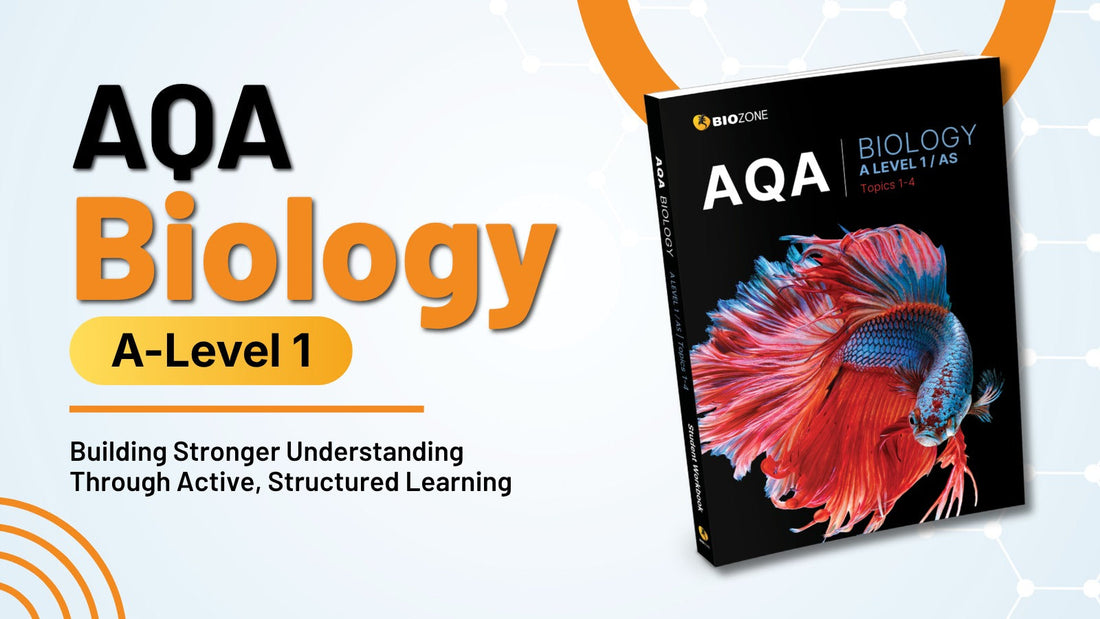
BIOZONE’s AQA Biology: A-Level 1 / AS is designed to support the first year of AQA A-Level and AS Biology through a worktext approach that combines textbook-style explanation with structured student activity.
The title is aligned with AQA A-Level Biology 7402, Version 1.5 dated 26 November 2021. The separate AS Biology qualification code is 7401, so qualification codes should not be used interchangeably.
The worktext covers the first-year subject areas and includes a chapter on mathematical and practical skills in Biology, followed by Biological Molecules, Cells, Organisms Exchange Substances, and Genetic Information, Variation, and Relationships.
Explanation and Activity in the Same Learning Process
One of the main differences between a conventional reference text and a worktext is the relationship between reading and doing.
Students can encounter an explanation and then move directly into an activity that asks them to interpret, apply, calculate, compare or explain. This creates a shorter distance between learning a concept and testing whether it has been understood.
That approach can be useful in lessons, but it is equally relevant to independent study because the next learning action is already built into the resource.
Full-Colour Visual Support
Biology includes structures and relationships that can be difficult to communicate through text alone.
Detailed diagrams and full-colour presentation can help students examine biological structures, follow relationships and connect written explanations with visual information. The value of a diagram increases when students are expected to interpret it rather than simply look at it.
Visual learning therefore works best when it remains part of the activity, not decoration around the activity.
Interactive and Digital Extensions
The title also connects learning with relevant digital resources, including QR-linked material and interactive 3D biological models where available.
Digital extensions can be particularly useful when they help students explore a structure or idea from a perspective that print cannot provide as easily.
However, digital features should be treated accurately. Wider BIOZONE digital and teacher functionality depends on the applicable institutional offering and current availability. Schools should confirm the access and licensing arrangement that applies at the time of adoption rather than assuming every digital feature is automatically included with an individual print purchase.
Model Answers and Self-Assessment
Model answers can support self-assessment when they are used after a student has attempted the task.
The useful sequence is simple: attempt the question, compare the response, identify missing or inaccurate points, and improve the answer.
This makes the model answer a learning tool rather than something to copy.
For independent learners, that process can provide a clearer way to judge progress. For teachers, it can also support discussion about the difference between a partly correct answer and a more complete scientific explanation.
Supporting Teachers as Well as Students
Resource selection is not only about what appears on the student page.
Teachers need materials that fit lesson planning, classroom delivery, homework, review and assessment preparation without creating unnecessary fragmentation.
BIOZONE’s AQA Biology title is supported by teacher-oriented materials, including presentation and digital resources, while access to wider BIOZONE digital features depends on the applicable institutional offering.
The broader value is an integrated teaching and learning environment in which student activities, visual resources and teacher support can remain connected to the same course structure.
Why This Matters for International Schools
International schools delivering AQA programmes often need to balance several priorities at once.
The resource must be curriculum-relevant, academically appropriate, workable in the classroom and useful for students outside lessons. Heads of Science and academic coordinators may also need to consider consistency across classes, teacher support, digital access and how easily a resource can be integrated into an existing programme.
For international schools in India, these questions are particularly relevant when evaluating AQA Biology resources. The decision is not simply which book contains the most content.
A more useful evaluation asks:
• Is the resource aligned with the course being delivered?
• Does it help students actively work with Biology?
• Are practical and mathematical skills integrated?
• Can students use it independently?
• Does it support teachers as well as learners?
• Are print and digital elements clearly connected and appropriately available?
These questions help move procurement from a catalogue comparison towards a learning-resource decision.
Using an AQA Biology Resource Across the Academic Year
During Classroom Teaching
A structured resource can give the class a common point of reference while allowing the teacher to introduce, explain and question concepts in their own way.
For Homework
Activities can extend the lesson without sending students into an unrelated resource or leaving them unsure about what to practise.
For Independent Study
Students can revisit the same explanation and activity sequence at their own pace, identify gaps and return to difficult sections.
During Revision
Completed activities, diagrams, notes and model-answer comparisons can help students see what has already been learned and what needs more attention.
For Exam Preparation
The resource can provide opportunities to practise interpretation, application, mathematical reasoning and scientific explanation. It should support preparation rather than promise examination outcomes.
Choosing Resources That Encourage Students to Think
The strongest AQA Biology learning resources are not necessarily the ones with the greatest number of pages or the longest list of features.
A more useful question is what students are asked to do while using them.
Do they only read, or do they interpret? Do they only recognise familiar language, or do they apply ideas? Do they only see a diagram, or do they work with it? Can they identify weaknesses in their own understanding and return to the relevant concept?
AQA A Level Biology becomes more manageable when students develop a routine of understanding, applying, checking and improving.
For teachers and schools, resource selection can support that routine by making active learning part of everyday course delivery rather than something saved for revision.
For students, the aim is not simply to complete Biology content. It is to become increasingly able to work with the Biology they have learned.
Explore BIOZONE AQA Biology: A-Level 1 / AS:
https://biozoneasia.com/products/aqa-biology-a-level-1-as