


Moving from earlier secondary-level Biology into AS and A-Level study changes more than the amount of content students are expected to learn. The subject begins to demand a different way of thinking.
Knowing biological terminology still matters, but success increasingly depends on understanding relationships between concepts, interpreting evidence, applying knowledge to unfamiliar situations, working confidently with practical methods, and using mathematical reasoning within biological contexts. Students who approach advanced Biology as a collection of facts to memorise can therefore find the transition challenging, even when they have previously performed well.
For students beginning OCR A Level Biology A, the first year is particularly important. The learning associated with OCR Biology A Modules 1–4 establishes much of the conceptual and scientific foundation that later study builds upon. That makes Year 1 more than an introductory stage. It is the point at which students begin developing the habits of thought required for increasingly advanced Biology.
Why the Transition to AS and A-Level Biology Can Be Challenging
At an earlier stage, students may often succeed by learning definitions, remembering processes and reproducing familiar explanations. At AS and A-Level, that knowledge still provides the starting point, but questions increasingly require students to do something with it.
They may need to interpret an unfamiliar graph, apply a familiar biological principle to a new context, evaluate an experimental method, explain the implications of data, or connect knowledge from several different topics.
A student might understand the definition of diffusion, for example, but advanced Biology asks them to consider how exchange surfaces are adapted, how concentration gradients influence movement, why organisms require specialised transport systems, and how these principles operate differently across biological systems.
The shift is therefore from simply asking “What do I know?” to increasingly asking “How can I use what I know to explain what is happening here?” This is one reason strong foundations during OCR A Level Biology A Year 1 are so important.
Understanding Biology Rather Than Memorising It
Biology inevitably contains terminology, processes and detail that students need to remember. But memorisation without conceptual understanding has limitations.
Consider subjects such as biological membranes, enzymes, cell division, exchange surfaces or immunity. Each can be studied as an individual chapter. In reality, however, biological systems do not operate in isolated textbook compartments.
Membrane structure affects movement of substances. Enzyme behaviour depends on molecular interactions. Cell organisation relates to specialised function. Exchange and transport depend on surface area, concentration gradients and physiological requirements. Disease and immunity draw on ideas about cells, molecules, recognition and biological interaction.
Effective advanced Biology learning therefore depends on students gradually building a connected conceptual framework. When students understand how ideas relate to one another, new information has somewhere to fit. They are better placed to interpret unfamiliar examples because they can reason from principles instead of searching their memory for an identical question they have seen before.
OCR Biology A Modules 1–4: Building the Year 1 Framework
OCR AS Level Biology A (H020) comprises Modules 1–4. These same modules also form the first-year content for students progressing through the full OCR A Level Biology A qualification (H420), which continues with Modules 5–6.
Module 1: Development of Practical Skills in Biology
Practical work is not an isolated component that sits alongside biological theory. It is one of the ways students learn how biological knowledge is created, tested and evaluated. Students need opportunities to think about experimental design, variables, measurement, data, reliability and interpretation. Developing OCR Biology practical skills therefore supports a much broader ability: scientific thinking.
Module 2: Foundations in Biology
This module brings together several concepts that continue to influence learning throughout advanced Biology, including cell structure, biological molecules, nucleotides and nucleic acids, enzymes, biological membranes, and cellular division and organisation. These are not simply early chapters to complete and leave behind. Ideas first developed here reappear throughout the course and support increasingly advanced reasoning.
Module 3: Exchange and Transport
Exchange surfaces, transport in animals and transport in plants offer excellent examples of why Biology should be learned through connected reasoning. Students can explore how organism size, surface area, diffusion distance and metabolic requirements influence biological structures and systems. Comparing biological problems and the adaptations that address them encourages students to move beyond factual recall toward explanation and application.
Module 4: Biodiversity, Evolution and Disease
Communicable disease, immune responses, biodiversity, classification and evolution introduce another set of interconnected ideas. Here, students encounter Biology at multiple levels—from interactions involving cells and pathogens to patterns across populations and species. The subject begins to show its wider coherence.
Practical and Mathematical Skills Should Develop Alongside Knowledge
One common mistake in advanced Biology study is to treat scientific skills as something to revise separately after the content has been learned. A stronger approach is to integrate them into everyday learning.
Mathematical reasoning may be needed when students interpret rates, ratios, percentages, graphical relationships or quantitative biological evidence. Practical thinking may be required when considering how evidence was generated. Data interpretation can appear within almost any topic.
Students therefore benefit when these skills are repeatedly applied within biological contexts. They should become accustomed to asking what the data shows, whether the evidence is sufficient, what biological principle explains the pattern and what variables could influence the result.
Active Learning Makes Application Part of the Learning Process
There is an important difference between recognising an explanation and being able to produce or apply one independently.
Students can sometimes read a textbook page and feel that they understand it because the explanation appears familiar and logical. The real test comes when the book is closed and they need to use that understanding themselves.
Structured questions, interpretation activities, application tasks, concept mapping and self-assessment encourage students to interact with information instead of simply reading it. For Biology teachers, this can also help reveal misconceptions earlier.
Helping Students See Connections Across the Course
A-Level Biology contains substantial detail, and students can easily develop a chapter-by-chapter view of the subject. Concept maps can be particularly useful because they encourage students to visualise relationships. Instead of seeing a list of separate headings, students see biological systems as networks of ideas. A conceptual pathway might connect biological molecules to membranes, membranes to exchange, exchange to transport systems, and transport to the physiological needs of organisms.
A Worktext Approach to OCR Biology A Year 1
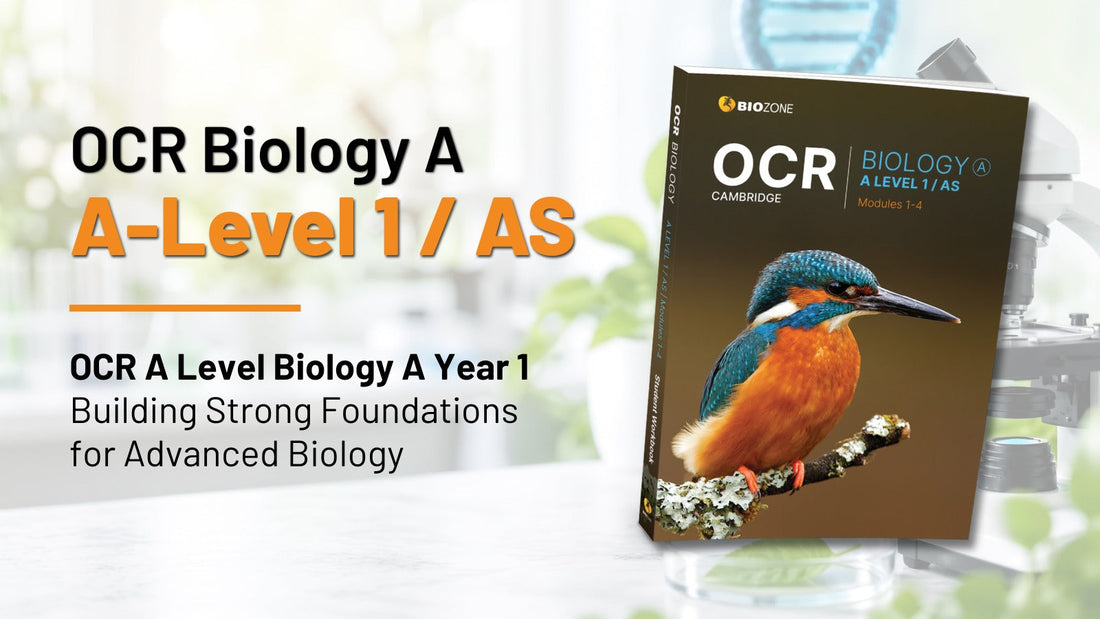
This need to combine explanation with active application is central to the approach taken in BIOZONE OCR Biology A: A-Level 1 / AS.
The resource is designed for the first-year / AS stage of OCR Biology A and focuses on Modules 1–4. Rather than operating purely as a conventional textbook, it uses a worktext approach, combining explanatory material with structured student activities.
The full-colour design supports visual learning, while two-page module introductions and concept maps help students see how important ideas are organised and connected. Structured activities provide opportunities to work with biological knowledge rather than simply read about it. The resource also incorporates practical and mathematical skill development.
Extending Learning Beyond the Printed Page
Complex biological structures and processes can sometimes be difficult to understand through text alone. Visual resources provide another route into the subject, especially when students need to understand spatial relationships, structural organisation or processes that are difficult to observe directly.
The resource includes QR-linked interactive 3D models. The Resource Hub extends this with supporting resources, while BIOZONE WORLD provides digital support associated with the programme, subject to current availability and institutional terms. These resources are intended to complement effective teaching and careful study rather than replace them.
Supporting Students in Checking Their Understanding
Independent study becomes increasingly important at AS and A-Level. Model answers can support this process when used thoughtfully. BIOZONE OCR Biology A includes model answers to its worktext questions, allowing learners to compare their responses with an available reference and consider what they included, what they omitted and how clearly they expressed their biological reasoning.
What Schools and Teachers Should Look for in Year 1 Biology Resources
For Heads of Science, Biology teachers and academic coordinators, selecting an OCR A Level Biology resource is not simply a question of whether the relevant topics appear in the contents list. A useful Year 1 resource should help students engage with those topics in ways that support deeper progression.
-
Make relationships between biological ideas visible.
-
Give students regular opportunities to apply knowledge.
-
Integrate practical and mathematical thinking.
-
Support both classroom use and independent study.
-
Provide visual explanations for complex concepts.
-
Help students review and assess their own understanding.
-
Keep learning clearly organised around the relevant course stage.
Strong Year 1 Foundations Support What Comes Next
The first year of advanced Biology should not be viewed simply as content that must be completed before students move on. It is where students begin developing the conceptual organisation, scientific reasoning, practical awareness and analytical habits that later A-Level study increasingly requires.
For OCR AS Level Biology A students, Modules 1–4 provide the environment in which these foundations can be established. The goal is not merely to remember more Biology. It is to begin thinking more biologically: questioning evidence, connecting ideas, interpreting information and applying principles with increasing independence.
BIOZONE OCR Biology A: A-Level 1 / AS is designed around that learning journey, combining clear explanations, structured activities, visual support, practical and mathematical skill development, concept maps, model answers and connected digital resources within a worktext format.
For teachers, students and schools looking at how to support the first-year stage of OCR Biology A, the most important question may therefore be broader than which book covers the syllabus. It is whether the learning resource helps students build, connect and use their biological understanding.
https://biozoneasia.com/products/ocr-biology-a-a-level-1-as